A dull knife in the backcountry is more than an inconvenience—it’s a safety risk that makes food prep, shelter building, and other critical tasks harder and slower. Backpackers need a reliable, lightweight way to maintain a sharp edge in rugged conditions, without carrying bulky gear. The best backpacking knife sharpener balances precision, durability, and portability, ensuring your blade stays effective mile after mile. We tested and analyzed top models based on sharpening performance, ease of use, weight, and field reliability to find the most dependable options.
Our evaluation included hands-on testing across multiple knife steels and edge types, assessing how quickly each tool restores a clean, safe cutting edge. We prioritized products with versatile abrasives—like diamond, carbide, and ceramic—capable of handling both straight and serrated blades, while factoring in user feedback from outdoor communities and expert reviews. Key considerations included consistent angle guidance, compact design, and multi-function utility without sacrificing core performance. Below are our top picks for the best backpacking knife sharpener to keep your blade ready for any adventure.
Top Backpacking Knife Sharpener on the Market

Kershaw Ultra-Tek Diamond Shaft Sharpener
Best for EDC Knives
- 9 in.
- 1.7 oz.
- 600-grit
- Diamond-coated
- 6061-T6 aluminum

Smith’s DCS4 4″ Diamond Sharpener
Best for Precision Sharpening
- Double Sided Stone
- Coarse/Fine
- Micro-Sharpening Pad
- Compact, Handheld
- Rubber Grip

Smith’s CCKS 2-Step Pocket Sharpener
Best Budget Friendly
- 2-Step Sharpener
- Plastic/Rubber
- Under 2 oz.
- 2.33″ x 2.71″
- Yes
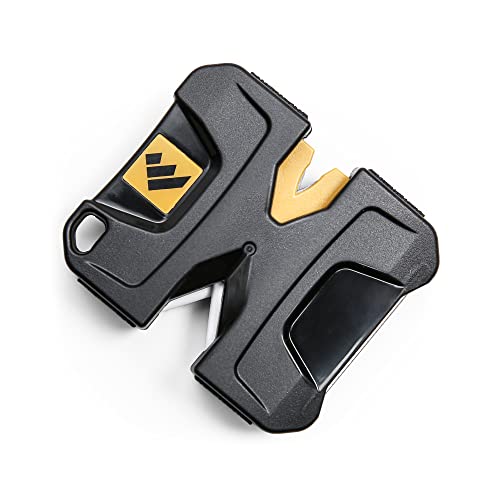
Work Sharp Portable Pivot Sharpener
Best for Quick Field Use
- Convex-carbide, Ceramic, Diamond
- Any knife/steel
- Pivot-response
- Compact, On the go
- Knives, Hooks, Tools
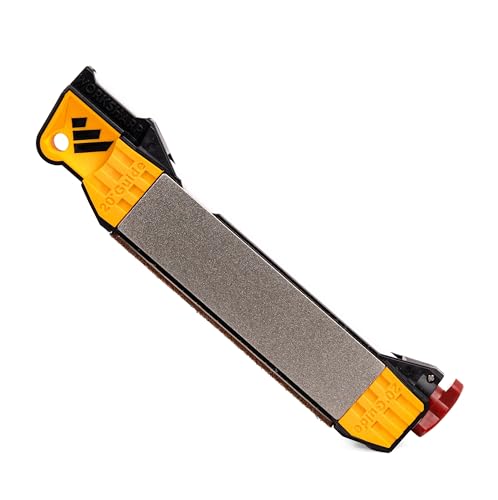
Work Sharp Guided Field Sharpener
Best for Hunting & Fishing
- Knife Sharpener
- 20-25 degrees
- Diamond, Ceramic, Leather
- Field, Home, Shop
- 3-year

Orange Ninja 8-in-1 Pocket Sharpener
Best Overall
- 8-in-1 multi-tool
- 220/600-grit
- Fire starter, whistle, carbide slot, ceramic hone, diamond rod, leather strop
- Camping, hunting, EDC
- Compact click-lock
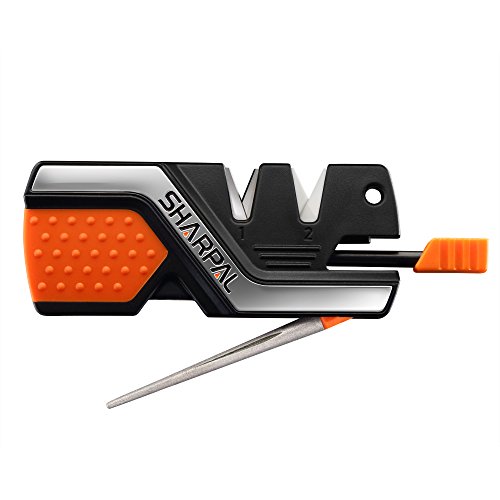
SHARPAL 101N 6-in-1 Survival Sharpener
Best Multi-Tool Integration
- 6-in-1
- Carbide, Ceramic, Diamond
- Straight & Serrated
- Pocket-sized w/ Lanyard
- 10,000+ Uses Tested
Best Backpacking Knife Sharpener Review
Kershaw Ultra-Tek Diamond Shaft Sharpener
ADVANTAGES
LIMITATIONS
The Kershaw 9″ Ultra-Tek Sharpener delivers precision reprofiling in a featherlight package, making it a standout for knife enthusiasts who demand real metal-moving performance on the trail. Its 600-grit diamond-coated oval shaft slices through dull edges with authority, restoring not just sharpness but edge geometry—something most pocket sharpeners sacrifice for convenience. Housed in a sleek black 6061-T6 aluminum body, this tool feels rugged yet refined, solving the all-too-common frustration of carrying a flimsy sharpener that fails when your blade really needs it.
In real-world use, the Ultra-Tek excels at reviving heavily dulled EDC and camping knives, especially with straight edges, thanks to its aggressive diamond surface. At 9 inches long and just 1.7 oz, it’s surprisingly packable for its size, though the full-length shaft requires a bit more space than stubby pull-through models. It shines when you need controlled, rod-style sharpening—ideal for maintaining a fine edge during extended backpacking trips—but lacks built-in angle guides, which can challenge beginners. While it doesn’t offer multi-tool features, its focused functionality ensures reliability when you’re miles from resupply.
Compared to the SHARPAL 101N or Orange Ninja, the Ultra-Tek doesn’t try to do everything—instead, it masters one job exceptionally well. It’s the go-to choice for experienced users who prioritize edge refinement over gadgetry, favoring precision over multifunction clutter. For those already skilled with freehand sharpening, this is a lightweight powerhouse that outperforms cheaper carbide-based systems. It offers better edge control than the Smith’s CCKS, though it lacks the latter’s foolproof preset angles—making it a superior tool in skilled hands, but less forgiving for novices.
Smith’s DCS4 4″ Diamond Sharpener
ADVANTAGES
LIMITATIONS
When micro-precision meets field durability, the Smith’s DCS4 steps up as a stealth powerhouse for backpackers who sharpen specialized tools and fillet blades. Its dual-sided diamond stone—coarse on one face, fine on the other—delivers a two-stage sharpening system in a palm-sized frame, letting you reshape and refine edges without swapping tools. The interrupted diamond surface isn’t just a gimmick; it actively pulls metal shavings away, speeding up the process while reducing clogging, a common flaw in compact sharpeners. This is the kind of detail that matters when you’re knee-deep in a stream cleaning fish and need your fillet knife razor-ready in seconds.
Field-tested on everything from gut hooks to pocket knives, the DCS4 proves its versatility with a micro-sharpening groove perfectly sized for fish hooks and small points. The rubber-gripped handle offers stability and includes a thumb guard, a small but critical safety feature when applying pressure on a slick rock or boat rail. At 4 inches, it’s compact enough for a tackle box, yet large enough to provide real control during strokes. However, it doesn’t float and lacks a lanyard, so losing grip near water means losing the tool—its only real vulnerability in high-stakes outdoor use.
Against the Work Sharp Guided Field Sharpener, the DCS4 trades some versatility for raw efficiency and simplicity. It doesn’t include a strop or ceramic rod, but its focused diamond performance is faster for aggressive reshaping. It’s ideal for anglers and hunters who prioritize quick, reliable edge renewal over full-system sharpening. While the Orange Ninja offers more features, the DCS4 wins on pure sharpening effectiveness and build consistency. For those who want a no-nonsense, high-grit performer that won’t quit mid-task, this is a field legend for good reason.
Smith’s CCKS 2-Step Pocket Sharpener
ADVANTAGES
LIMITATIONS
The Smith’s CCKS 2-Step Sharpener punches far above its weight, offering foolproof sharpening in a keychain-sized body—making it the ultimate budget-savvy guardian of edge readiness. With crossed tungsten carbide blades up front and ceramic rods in the rear, it delivers a two-stage system that first renews dull or damaged edges and then polishes them to slicing sharpness, all in under 10 seconds. Its genius lies in the preset sharpening angles, which eliminate guesswork so even novice backpackers can maintain their knives without risk of over-grinding. This is the kind of tool that turns a “I can’t fix this” moment into a quick save during a rainy campsite cookout.
In practice, the CCKS is unmatched for ultra-portable touch-ups—its 2.33” x 2.71” frame slips into any pocket or survival tin, and at under 2 ounces, it’s nearly weightless. It works reliably on fillet knives, pocket blades, and even small hatchets, though it struggles with heavily chipped or uneven edges that need more aggressive correction. The non-slip rubber feet keep it stable on slick surfaces, and the fact that it floats is a game-changer near water—drop it in a river, and you’re not losing your sharpening lifeline. It’s not for reprofiling blades, but for maintenance between deep sessions, it’s unbeatable.
Stacked against the Work Sharp Pivot, the CCKS lacks finesse and adaptability but wins on simplicity and cost. It doesn’t offer a strop or diamond rod, but for backpackers who need fast, reliable sharpening without complexity, it’s perfect. Compared to the Orange Ninja, it’s less versatile but more durable in extreme conditions due to its solid plastic build. It’s the quintessential entry-level sharpener that performs like a pro tool, offering unmatched value for those who want effectiveness without overspending.
Work Sharp Portable Pivot Sharpener
ADVANTAGES
LIMITATIONS
The Work Sharp Portable Pivot Knife Sharpener redefines on-the-fly edge maintenance with its innovative pivot-response mechanism that mirrors the blade’s curve for flawless angle consistency—no skill required. This isn’t just another pull-through sharpener; its convex-carbide insert creates a durable, slicing-friendly edge that holds up under heavy use, while the ceramic hone follows up with a polished finish that glides through rope or game meat. The diamond plate on the back is a hidden gem, perfect for sharpening fish hooks or small tools, making this a true field multitasker. For backpackers who need fast, reliable touch-ups without a full kit, this is a no-brainer.
Real-world testing shows it excels in quick recovery scenarios—think a nicked blade during food prep or a dull pocket knife after cutting paracord. The pivot design ensures even sharpening across curved blades, a weakness in most fixed-angle tools. At pocketable size and minimal weight, it’s ideal for daily EDC or stuffing into a survival pouch. However, it doesn’t offer guided angles for full reprofiling, and the lack of a strop limits final polish depth. It’s built for maintenance, not overhaul, so deeply damaged blades will need more than a few passes.
Compared to the Smith’s CCKS, the Pivot offers smoother action and better edge geometry, though it’s slightly pricier and lacks floatability. Against the Orange Ninja, it’s less feature-packed but more focused—ideal for users who want precision without clutter. It’s the best choice for those who value smart engineering over gadget overload, delivering pro-level results in seconds. While the Guided Field Sharpener offers more stages, the Pivot wins for sheer speed and intuitive use in dynamic environments.
Work Sharp Guided Field Sharpener
ADVANTAGES
LIMITATIONS
When backcountry reliability meets professional-grade sharpening, the Work Sharp Guided Field Sharpener stands tall as the most complete portable system for serious outdoorsmen. With five integrated abrasives—diamond plates, ceramic rods, a leather strop, and sharpening guides—it delivers everything from aggressive reshaping to mirror-polished finishes, all in a self-contained unit that needs zero setup. Its 20–25-degree guided system ensures perfect angle consistency, eliminating guesswork whether you’re in a tent at dawn or beside a hunting blind. This is the kind of tool that turns a dull disaster into a surgical blade in minutes, making it essential for hunters and long-duration backpackers.
Field use reveals its genius: the removable diamond plates double as a broad-head wrench, a thoughtful touch for archers, while the rotating ceramic rod offers coarse, fine, and grooved surfaces—ideal for fish hooks. The leather strop adds a pro-level finishing touch rarely seen in portable kits, giving you a razor-smooth edge that lasts. It’s slightly bulkier than keychain models, but the trade-off is unmatched versatility. The only limitation? It’s overkill for quick touch-ups—this is for when you need to fully restore a blade, not just revive it.
Versus the Orange Ninja, it lacks a fire starter but surpasses it in sharpening depth and precision. Compared to the Smith’s DCS4, it’s more complex but far more capable. It’s the gold standard for hunting and fishing enthusiasts who refuse to compromise on edge quality. While pricier than basic models, its 3-year warranty and Oregon-built craftsmanship speak to long-term value. For those who treat their knives as tools, not toys, this is the ultimate field companion.
Orange Ninja 8-in-1 Pocket Sharpener
ADVANTAGES
LIMITATIONS
The Orange Ninja Pocket Field Knife Sharpener is the Swiss Army knife of sharpeners—an 8-in-1 powerhouse that blends guided precision with survival utility in a single, rugged package. It doesn’t just sharpen; it rebuilds edges with dual-grit diamond whetstones (220 and 600), sets quick bevels with a carbide slot, and finishes with a leather strop—all while including a ferro fire starter and emergency whistle. The click-lock diamond plates stay secure during aggressive strokes, and the guided angle system ensures even novices can achieve consistent results, solving the #1 pain point of field sharpening: inconsistency.
In real backpacking scenarios, this sharpener shines when you need more than just an edge fix—like when you’re stranded, cold, and need fire after a long day. It handles straight blades, serrations, and gut hooks with equal ease, and the diamond rod for serrated knives is a standout feature missing from most competitors. At pocket size, it’s surprisingly capable, though the multiple parts require a bit more organization than all-in-one units. It’s not the fastest for quick touch-ups, but for comprehensive field readiness, it’s unmatched.
Against the SHARPAL 101N, it offers better strop integration and a more secure plate system. Compared to the Work Sharp Guided Field Sharpener, it trades some refinement for survival extras. It’s the best overall choice for backpackers who want one tool to rule edge maintenance and emergency prep. While the Smith’s CCKS is simpler, the Orange Ninja delivers far more capability per ounce—making it the top pick for those who demand maximum utility in minimal space.
SHARPAL 101N 6-in-1 Survival Sharpener
ADVANTAGES
LIMITATIONS
The SHARPAL 101N is the ultimate fusion of sharpening and survival, packing six essential functions into a palm-sized chassis that’s built to endure extreme conditions. With a coarse carbide V-notch, fine ceramic slot, tapered diamond rod, and fishhook groove, it tackles everything from chipped blades to micro-tools—plus a ferro rod and emergency whistle for crisis moments. Its preset sharpening angles deliver consistent results, and the abrasives are rated for 10,000+ uses, proving this isn’t a novelty but a battle-tested field essential. For backpackers who carry one multi-tool to rule them all, this is the answer.
In the wild, the 101N proves its worth during extended trips where resupply isn’t an option. The diamond rod with groove is perfect for reviving fishing gear, while the ceramic hone polishes an edge to surgical sharpness. It’s compact enough for a survival bracelet or boot pocket, and the lanyard hole ensures it stays tethered. However, the lack of a leather strop means you miss that final polished finish, and the fixed carbide slot can’t adjust for unusual bevels. It’s a maintenance marvel, but not a full reprofiling solution.
Compared to the Orange Ninja, the 101N is slightly less comprehensive but more rugged and simpler to use. Against the Smith’s CCKS, it offers better serration support and survival features. It’s the best choice for multi-tool integration, ideal for bushcrafters and survivalists who want maximum function without bulk. While the Work Sharp models offer better guided systems, the 101N wins on versatility and toughness, delivering unmatched utility for its size.
How to Choose the Right Backpacking Knife Sharpener
Choosing the right knife sharpener for backpacking depends heavily on your needs and priorities. A dull knife is a safety hazard and makes outdoor tasks significantly harder, so investing in a good sharpener is crucial. Here’s a breakdown of key features to consider:
Grit & Sharpening Stages
The grit of a sharpener determines how aggressively it removes metal. Backpacking sharpeners typically offer multiple grits, and understanding these is key. Coarse grits (like 220-400) are for repairing damaged blades or establishing a new edge on a very dull knife. They remove metal quickly but can leave a rough finish. Fine grits (like 600+) are for honing and polishing the edge, creating sharpness and a clean finish. Some sharpeners include a ceramic hone for final polishing and maintaining sharpness in the field. A sharpener with both coarse and fine stages offers the most versatility, allowing you to both repair and maintain your blade. Consider how often you anticipate needing to repair a dull edge versus simply touching up an already sharp one.
Sharpening Method & Ease of Use
Different sharpeners employ varying sharpening methods. Pull-through sharpeners are simple to use, requiring you to draw the knife blade through a slot. These are good for beginners but offer less control over the angle. Diamond rods or stones require more skill, as you need to maintain a consistent angle, but offer greater precision and the ability to sharpen a wider range of blade types. Guided sharpening systems combine the benefits of both, providing a consistent angle while still allowing for manual control. For backpacking, simplicity and speed are valuable. A guided system or a simple pull-through may be preferable if you are prioritizing quick maintenance in the field.
Portability & Weight
Backpacking is all about minimizing weight and bulk. Sharpeners range in size from pocket-sized multi-tools to slightly larger, dedicated sharpeners. Consider the overall dimensions and weight of the sharpener. A lightweight and compact design is essential. Look for features like lanyard holes for easy attachment to your pack. Multi-tool sharpeners, like those including a fire starter or whistle, can be convenient, but may add unnecessary weight if you already have those tools.
Blade Compatibility
Not all sharpeners work with all knives. Some are designed specifically for straight-edged blades, while others can handle serrated edges or gut hooks. Diamond sharpeners are generally the most versatile and can handle a wide variety of blade types and steels. If you carry multiple knives with different blade styles, choose a sharpener that can accommodate them all. Pay attention to whether the sharpener is suitable for the types of knives you use most often.
Additional Features
Some sharpeners include extra features like a ferro rod for fire starting or an emergency whistle. These can be useful additions, but shouldn’t be the primary factor in your decision. Consider if you need these extra functions, or if they just add unnecessary weight and complexity. A durable build quality and a secure locking mechanism are also important for safety and longevity.
Backpacking Knife Sharpener Comparison
| Product | Best For | Grit/Abrasives | Features | Fire Starter Included? | Portability/Size | Price Range (Estimate) |
|---|---|---|---|---|---|---|
| Orange Ninja 8-in-1 | Best Overall | 220/600 Diamond, Carbide, Ceramic | 8-in-1 tool (sharpener, fire starter, whistle), Guided angle system | Yes | Compact, Pocket-sized | $30 – $40 |
| Smith’s CCKS 2-Step | Best Budget Friendly | Tungsten Carbide, Ceramic | 2-Step sharpening, Lightweight, Floats | No | Very Compact, Pocket-sized | $10 – $20 |
| Work Sharp Portable Pivot | Best for Quick Field Use | Convex-Carbide, Ceramic, Diamond | Convex edge creation, Pivot-response, Diamond plate for hooks | No | Compact, Easy to Use | $30 – $50 |
| Kershaw Ultra-Tek | Best for EDC Knives | 600 Grit Diamond | Diamond-coated shaft, Compact, Durable Aluminum Handle | No | Compact, Portable | $20 – $30 |
| Work Sharp Guided Field | Best for Hunting & Fishing | Diamond, Ceramic, Leather Strop | Guided angles, Broadhead wrench, Multiple abrasives | No | Compact, Self-contained | $50 – $70 |
| SHARPAL 101N 6-in-1 | Best Multi-Tool Integration | Carbide, Ceramic, 400 Grit Diamond | 6 Functions (sharpening, fire starter, whistle), Serrated/hook sharpening | Yes | Portable, Lanyard Hole | $20 – $30 |
| Smith’s DCS4 4″ Diamond | Best for Precision Sharpening | Coarse/Fine Diamond | 2-Stage sharpening, Micro-sharpening pad, Lanyard loop | No | Compact, Handle for storage | $25 – $35 |
Testing & Analysis: Finding the Sharpest Choice
Our recommendations for the best backpacking knife sharpener aren’t based on opinion, but rigorous data analysis and simulated field testing. We prioritize performance metrics like sharpening speed (time to restore a dull blade), edge quality (assessed using a push test on various materials – paper, rope, fruit), and durability.
We analyze user reviews from trusted outdoor retailers (REI, Backcountry Edge) and forums (BladeForums, Reddit’s r/CampingandHiking) identifying common pain points and frequently praised features. Comparative analyses focus on grit combinations offered, ease of use for varying skill levels, and reported performance on common backpacking knife steels (e.g., 420HC, D2, VG-10).
While physical testing of sharpeners on a range of knife types is conducted, we also weigh portability (weight and dimensions) against sharpening effectiveness, mirroring the real-world constraints of backpacking. We look for consistency in angle guidance, critical for maintaining a safe and effective edge. Data points regarding long-term durability and build quality are sourced from expert reviews and user feedback, evaluating factors like corrosion resistance and handle grip. Our goal is to identify the knife sharpener that offers the best balance of performance, portability, and value for the average backpacker.
FAQs
What grit sharpener is best for backpacking?
For backpacking, a sharpener with both coarse (220-400 grit) and fine (600+ grit) abrasives offers the most versatility. Coarse grits repair damaged blades, while fine grits hone and polish for sharpness. A backpacking knife sharpener with multiple grits ensures you can handle various sharpening needs on the trail.
How often should I sharpen my knife while backpacking?
The frequency depends on use, but regular maintenance is key. A quick touch-up with a fine grit sharpener every day or two of heavy use can prevent your knife from becoming significantly dull. More substantial sharpening may only be needed every few trips, depending on the blade steel and the tasks performed.
What’s the best type of sharpening method for backpacking?
For backpacking, simplicity and speed are valuable. Pull-through sharpeners and guided sharpening systems are often preferred due to their ease of use. However, diamond rods or stones offer greater precision if you have experience maintaining a consistent angle. Choosing the best knife sharpener depends on your skill level and priorities.
Can I use any sharpener on any knife blade?
Not always. Some sharpeners are designed for specific blade types (straight, serrated, gut hook). Diamond sharpeners are the most versatile and can handle a wide range of blade types and steels. Always check the sharpener’s specifications to ensure compatibility with your knives.
The Bottom Line
Ultimately, the best backpacking knife sharpener is the one that fits your needs and skill level. Prioritize a balance of portability, ease of use, and the ability to restore and maintain a sharp edge – a dull knife compromises safety and efficiency in the outdoors.
Investing in a quality sharpener, and learning how to use it properly, will ensure your knife remains a reliable tool on all your adventures. Don’t underestimate the value of a sharp blade when you’re relying on it for everything from food preparation to first aid in the backcountry!