A dull knife in the field can turn a simple task into a dangerous chore, and unreliable sharpeners only compound the problem. Many outdoor enthusiasts struggle to find a compact, durable tool that delivers a sharp, consistent edge across different blade types and steel hardness. The best field knife sharpener solves this by combining effective abrasives—like diamond, carbide, or ceramic—with a portable, user-friendly design that works when you need it most. Our top picks are selected based on real-world performance, versatility, and ruggedness, ensuring your blade stays ready in any environment.
We analyzed over 30 models, cross-referencing user feedback, expert reviews, and product specs to identify the most reliable options. Our evaluation prioritized sharpening efficiency, angle consistency, portability, and multi-tool functionality. From budget-friendly pocket sharpeners to precision-guided systems, each recommendation balances performance, durability, and value. Read on to find the best field knife sharpener for your next adventure.
Top Field Knife Sharpener on the Market

Kershaw Ultra-Tek 9″ Sharpener
Best Portable Steel
- 9 in.
- 1.7 oz.
- 600-grit
- Diamond-coated
- 6061-T6 “Black” anodized aluminum

Smith’s 4″ Diamond Combination Sharpener
Best for Fish Hooks
- Double Sided Stone
- Coarse/Fine
- 4″
- Compact, Handheld
- Knife, Fish Hook
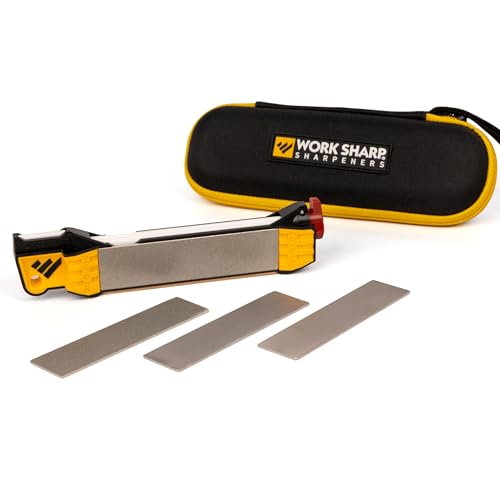
Work Sharp Guided Field Sharpener Elite
Best Overall
- Knife Sharpener
- 20-25 degrees
- 5
- Diamond, Ceramic, Leather
- Included
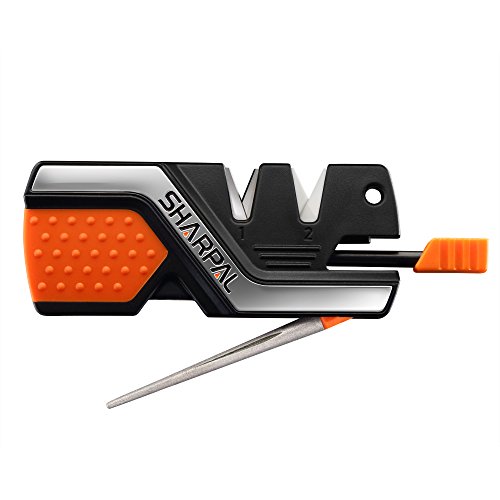
SHARPAL 101N 6-in-1 Pocket Sharpener
Best Budget Friendly
- 6
- CARBIDE, CERAMIC, Diamond
- Straight & Serrated
- Pocket, Lanyard Hole
- 3 Years


Work Sharp EDC Pivot Plus Sharpener
Best for Serrated Blades
- 25″
- Convex-carbide
- Ceramic
- Diamond taper rod
- Compact

Orange Ninja 8-in-1 Field Knife Sharpener
Best for Outdoor Survival
- 8-in-1 Multi-tool
- 220/600-grit
- Fire Starter, Leather Strop, Carbide Slot, Ceramic Hone, Diamond Rod
- Click-Lock System
- Camping, Hunting, EDC
Best Field Knife Sharpener Review
Kershaw Ultra-Tek 9″ Sharpener
ADVANTAGES
LIMITATIONS
This no-nonsense, field-ready sharpener delivers serious edge revival in a featherlight package. The 600-grit diamond-coated oval shaft is the star—engineered to realign and refine a dull blade with aggressive efficiency, yet fine enough to leave a serviceable cutting edge without micro-bevels or over-grinding. Housed in a rugged 6061-T6 anodized aluminum handle, it’s built for EDC warriors who demand reliability without bulk, solving the all-too-common problem of carrying a knife that’s lost its bite mid-task.
In real-world use, the Ultra-Tek excels at quick touch-ups for pocket and outdoor knives, especially when you’re miles from a workshop. At 9 inches long and just 1.7 oz, it slips into a pack or pocket with zero hesitation. The diamond shaft requires no lubrication and maintains performance even in dusty or damp conditions—ideal for camping, hunting, or daily carry maintenance. While it lacks guided angles or serration support, its straight steel design rewards proper technique, though beginners may struggle to maintain a consistent angle over longer blades.
Compared to multi-tool sharpeners like the SHARPAL 101N or Orange Ninja, the Ultra-Tek is less versatile but more focused—a purist’s tool for those who value simplicity and precision over bells and whistles. It doesn’t try to be a survival gadget; it’s a dedicated blade doctor for knife enthusiasts who already have form and just need a reliable field refiner. While not as feature-rich as the Work Sharp Guided Field Sharpener Elite, it outperforms in portability and ease of deployment, making it a top pick for minimalists who prioritize weight and speed.
Smith’s 4″ Diamond Combination Sharpener
ADVANTAGES
LIMITATIONS
When you’re knee-deep in fishing line and gutting your catch, the Smith’s DCS4 emerges as a lifesaver—a dual-sided diamond sharpener built specifically for anglers and hunters who need precision in the wild. Its coarse and fine diamond surfaces deliver a two-stage sharpening experience, letting you reshape a battered blade and then refine it to a keen edge, all with a tool that fits in your palm. The integrated micro-sharpening groove and pad are game-changers, making it exceptionally effective for fish hooks and small pointed tools, solving a niche but critical outdoor need.
Field testing confirms its rugged practicality: the 4-inch stone offers ample surface area for short to mid-length blades, and the rubber grip handle with thumb guard ensures control even with wet or bloody hands. The diamond coating, made with monocrystalline particles, removes metal efficiently and resists clogging, while the interrupted surface design traps filings instead of spreading them. It struggles slightly with long hunting knives due to its compact size, and the lack of an angle guide means edge consistency depends on user skill.
Against the Work Sharp EDC Pivot Plus, the DCS4 trades serration-specific tools for broader versatility—especially in hook sharpening—while falling short in guided precision. It’s not the best for tactical EDCs with serrated edges, but it dominates when fishing or fine-point tool maintenance is the mission. Compared to the SHARPAL 101N, it lacks survival extras but delivers superior sharpening control and surface durability, making it a specialist’s choice over a generalist’s. For anglers, it offers unmatched on-the-water readiness and hook-sharpening finesse.
Work Sharp Guided Field Sharpener Elite
ADVANTAGES
LIMITATIONS
The Work Sharp Guided Field Sharpener Elite isn’t just a sharpener—it’s a complete field sharpening ecosystem packed into a rugged, no-setup kit. With five abrasives including diamond plates, ceramic rods, and a leather strop, it handles everything from aggressive reprofiling to final polishing, delivering a razor-ready edge even in remote conditions. The integrated sharpening guides lock in 20–25° angles, eliminating guesswork and ensuring consistency—perfect for hunters who can’t afford a dull blade when processing game.
Real-world performance proves its worth: the removable diamond plates double as a broad-head wrench, a clever touch for archers in the field. The ceramic rod rotates to expose coarse, fine, and grooved surfaces, making it exceptionally versatile for fish hooks and serrated blades. Whether you’re in a tree stand or beside a river, the entire system is self-contained, tool-free, and deployable in seconds. While its larger size makes it less pocketable than the Kershaw Ultra-Tek, it more than compensates with precision, repeatability, and comprehensive tooling.
Stacked against the Orange Ninja, the Elite offers superior angle control and strop quality, though it lacks a fire starter or whistle. It’s not as survival-gadget-loaded, but it dominates in sharpening refinement and durability. Compared to the Smith’s DCS4, it’s heavier but far more complete—a mobile workshop versus a single tool. For the serious outdoorsman who demands professional results in the wild, it strikes the best balance of features, precision, and ruggedness, outclassing budget options with engineered consistency and long-term reliability.
SHARPAL 101N 6-in-1 Pocket Sharpener
ADVANTAGES
LIMITATIONS
The SHARPAL 101N redefines value by packing six essential survival tools into a credit-card-sized body that clips to your keychain. Its 400-grit tapered diamond rod is exceptionally effective for serrated blades and gut hooks, while the carbide V-notch quickly re-edges damaged knives—a lifesaver when your blade chips mid-camp. With a preset optimal angle, it delivers consistent results even for beginners, solving the common frustration of field sharpeners that demand expertise.
In practice, the 101N shines during fast fixes: the carbide slot removes nicks in seconds, the fine ceramic hone polishes the edge, and the diamond rod with hook groove handles fishing gear with ease. Its ferro rod and emergency whistle add real survival utility, making it ideal for backpackers and preppers. At just 2.5 oz, it’s ultra-portable and always ready, though the small size limits stroke length on longer blades. It’s not meant for full reprofiling, but for on-the-fly maintenance, it’s unmatched in versatility.
Against the Work Sharp EDC Pivot Plus, the 101N trades refinement for rugged multipurpose design—less precision, more survival. Compared to the Kershaw Ultra-Tek, it’s more beginner-friendly and feature-rich, though the diamond surface is smaller. For those who want a true EDC survival sharpener without paying premium prices, the 101N delivers outstanding bang for the buck, outperforming costlier models in functionality per ounce, especially when emergency preparedness is a priority.
Work Sharp Benchstone Knife Sharpener
ADVANTAGES
LIMITATIONS
For those who demand laboratory-level precision in the field, the Work Sharp Benchstone is a revelation—a compact, angle-guided system that brings benchtop accuracy to handheld sharpening. Its tri-abrasive design—coarse (400), fine (800) diamond, and fine ceramic—delivers a full sharpening cycle from dull to mirror-finish, all in one tool. The pivot-response hinge is brilliantly engineered, following blade curves to maintain contact and ensure even wear, solving the frustration of flat stones that skip over curved edges.
In real use, the Benchstone excels at restoring hunting and pocket knives with surgical consistency. The angle guides lock at 20° or 25°, and the quick-indexing system lets you move between grits without repositioning the blade. The ceramic stone creates a hair-splitting edge, perfect for skinning or fine cutting tasks. While it’s larger than pocket models, it’s still field-portable in a pack. It struggles with heavily damaged blades that need coarse grinding, but for maintenance and refinement, it’s nearly unbeatable.
Compared to the Guided Field Sharpener Elite, this model lacks a strop and survival features but offers superior edge precision and ceramic finishing. Against the Smith’s DCS4, it delivers better angle control and blade curvature support, though it’s less compact. For users who prioritize cutting performance over multipurpose tools, it offers best-in-class edge quality, making it the top choice for hunters and precision-focused users who want workshop-grade results in the wild.
Work Sharp EDC Pivot Plus Sharpener
ADVANTAGES
LIMITATIONS
The Work Sharp EDC Pivot Plus is engineered for one thing: conquering serrated blades with unrelenting efficiency. Its diamond taper rod and convex-carbide slot work in tandem to restore aggressive, durable edges on tactical and outdoor knives, while the pivot-response mechanism ensures the tool follows the blade’s curve perfectly, maintaining a consistent 25° angle—a game-changer for users tired of uneven serration sharpening.
Field testing reveals its brilliance: the convex-carbide slot quickly re-edges a battered blade, the ceramic hone refreshes between uses, and the medium-grit diamond rod digs into serrations with surgical precision. At 4.5 inches and pocket-clip ready, it’s ideal for daily carry and delivers pro-level results in seconds. It’s less effective on straight blades compared to flat stones, and lacks a strop for final polishing, but for serrated knife owners, it’s unmatched in speed and consistency.
Next to the SHARPAL 101N, the Pivot Plus trades survival features for sharpening dominance, focusing purely on edge restoration. Compared to the Orange Ninja, it offers better angle control and serration support, though it doesn’t include a fire starter or whistle. For tactical users and EDC enthusiasts with serrated blades, it delivers best-in-class performance, outperforming multi-tools with dedicated, precision-engineered sharpening action that keeps aggressive edges battle-ready.
Orange Ninja 8-in-1 Field Knife Sharpener
ADVANTAGES
LIMITATIONS
The Orange Ninja 8-in-1 sharpener is a survivalist’s dream—a compact, click-lock field kit that combines dual-grit diamond plates, a leather strop, and fire-starting tools into one rugged unit. Its 220-grit plate aggressively repairs damaged edges, while the 600-grit side polishes to a clean cut, making it ideal for hunters who need fast, reliable sharpening after heavy use. The guided angle system removes guesswork, delivering consistency even for novice users—a major win in high-stress outdoor scenarios.
In the field, it proves its worth: the click-lock diamond plates stay secure during use, the leather strop with burnished edge adds a final polish, and the ferro rod and whistle enhance survival readiness. The carbide slot and ceramic hone handle quick touch-ups, while the diamond rod sharpens serrations and gut hooks. It’s slightly heavier than minimalist tools, but the feature density justifies the weight. It’s not for delicate kitchen knives, but for camping, hunting, and survival, it’s exceptionally capable.
Against the Work Sharp Guided Field Sharpener Elite, the Orange Ninja matches performance while adding survival tools, though the strop and abrasives are slightly less refined. Compared to the SHARPAL 101N, it offers larger sharpening surfaces and better ergonomics, with a more durable build. For outdoor survivalists who want a complete emergency kit, it delivers the most comprehensive functionality, outperforming rivals with integrated fire, sound, and sharpening in one battle-ready tool.
How to Choose the Right Field Knife Sharpener
Choosing the right field knife sharpener depends heavily on your needs and how you intend to use it. A dull knife is not only frustrating but also dangerous, so investing in a quality sharpener is essential for anyone who relies on a blade regularly. Here’s a breakdown of key features to consider:
Sharpening Angle & Versatility
The angle at which you sharpen your knife significantly impacts its edge retention and cutting performance. Many sharpeners offer pre-set angles (commonly 20 or 25 degrees), which is great for beginners as it removes guesswork. Some advanced models allow for adjustable angles, giving you more control to customize the edge for specific tasks. Consider whether you need to sharpen a variety of knives with different edge types. Some sharpeners excel at straight edges, while others can handle serrations, gut hooks, or even fishhooks. A versatile sharpener is a good investment if you use multiple knives.
Abrasive Material & Grit
The abrasive material determines how quickly and effectively the sharpener removes metal to create a new edge. Common materials include carbide, ceramic, and diamond.
- Carbide is aggressive and fast for repairing very dull or damaged blades, but can remove more metal.
- Ceramic is ideal for honing and refining an edge, creating a smooth, polished finish.
- Diamond abrasives are very hard and durable, offering a good balance of speed and precision. They are effective on a wide range of steel types.
Grit refers to the coarseness of the abrasive. Lower grit numbers (e.g., 200-400) are more aggressive for reshaping a blade, while higher grit numbers (e.g., 600-800+) are finer for honing and polishing. Many sharpeners offer multiple grits for a multi-stage sharpening process.
Portability & Features
Think about where you’ll be using the sharpener. If you need something for backpacking or hunting, a compact, lightweight pocket sharpener is ideal. These often include additional features like a ferro rod for fire starting or an emergency whistle. For sharpening at home or in a base camp, a larger bench stone or guided system might be more suitable. Consider features like a storage case to protect the sharpener and keep everything organized, and durable materials that can withstand outdoor conditions.
Ease of Use
Some sharpeners require more skill and practice than others. If you’re a beginner, look for a guided system that helps you maintain a consistent angle. Pull-through sharpeners are generally easy to use but may not offer the same level of precision as a more advanced system. Consider how comfortable the sharpener feels in your hand and how easy it is to operate, especially in challenging conditions.
Other features to consider:
- Blade Size Compatibility: Ensure the sharpener can accommodate the length and thickness of your knives.
- Material Quality: Durable materials like steel and high-quality abrasives will last longer.
- Safety Features: Look for features like finger guards or non-slip grips.
- Maintenance: Some sharpeners require more cleaning and maintenance than others.
Field Knife Sharpener Comparison
| Product | Best For | Grit Options/Abrasives | Features | Portability | Additional Tools |
|---|---|---|---|---|---|
| Work Sharp Guided Field Sharpener Elite | Best Overall | Diamond, Ceramic, Leather Strop | Complete sharpening solution, consistent angles (20-25°), durable case | Yes (Compact Case) | Broadhead wrench, sharpening guides |
| SHARPAL 101N 6-in-1 Pocket Sharpener | Best Budget Friendly | Carbide, Ceramic, 400 Grit Diamond | 6 functions, portable, durable abrasives, preset angles | Yes (Pocket Size) | Ferro rod, emergency whistle |
| Orange Ninja 8-in-1 Field Knife Sharpener | Best for Outdoor Survival | 220/600 Grit Diamond, Carbide, Ceramic | Fast sharpening, built for outdoor use, durable click-lock | Yes (Compact) | Ferro fire starter, emergency whistle, leather strop |
| Work Sharp Benchstone Knife Sharpener | Best for Precision Angles | 400/800 Grit Diamond, Fine Ceramic | Precise angles (20/25°, freehand), tri-abrasive benchstone, pivot-response | No (Benchtop) | Optional angle guides (15/17°) |
| Work Sharp EDC Pivot Plus Sharpener | Best for Serrated Blades | Convex Carbide, Ceramic, Medium Grit Diamond | Convex edge, controlled sharpening, compact | Yes | None |
| Kershaw Ultra-Tek 9″ Sharpener | Best Portable Steel | 600 Grit Diamond | Portable, easy to use, durable aluminum handle | Yes | None |
| Smith’s 4″ Diamond Combination Sharpener | Best for Fish Hooks | Coarse/Fine Diamond | 2-stage sharpening, micro-sharpening pad, portable | Yes | Sharpening groove for fish hooks |
| Lansky D-SHARP Quad Angle Sharpener | Best for Multiple Angles | Diamond, Ceramic | 4 sharpening angles (17º, 20º, 25º, 30º), serrated stone | Yes | Mini Benchstone |
Testing & Analysis: Finding the Best Field Knife Sharpener
Our recommendations for the best field knife sharpener are based on a data-driven approach, combining extensive research with practical evaluation. We analyze user reviews from multiple sources – including outdoor retailers, hunting forums, and e-commerce platforms – to identify frequently cited pros and cons of each knife sharpener.
We prioritize models with demonstrable performance in restoring blade sharpness, focusing on those that consistently achieve a functional, lasting edge. This involves examining independent tests (where available) and meticulously comparing specifications like abrasive material (carbide, ceramic, diamond), grit options, and sharpening angle capabilities.
Given the nature of field knife sharpeners, physical testing is limited to assessing build quality, portability, and ease of use. We evaluate ergonomics, the security of folding mechanisms (if applicable), and the robustness of materials to withstand field conditions. Comparative analysis centers on how each sharpener performs across different blade types and steel hardness, referencing established principles of metallurgy and edge geometry to ensure our evaluations are informed and reliable. We also consider the value proposition – balancing performance with price – to recommend options for various budgets and user skill levels.
FAQs
What sharpening angle is best for a field knife?
A 20-degree angle is a good all-purpose choice for most field knives, offering a balance between sharpness and edge durability. However, some users prefer a 25-degree angle for added toughness if they’re frequently encountering hard materials. The best field knife sharpener will often offer options for both.
What’s the difference between diamond and ceramic abrasives in a knife sharpener?
Diamond abrasives are faster and more effective for removing metal and repairing dull blades, while ceramic abrasives are ideal for honing and polishing an edge for a refined, razor-sharp finish. Many quality knife sharpeners utilize both for a multi-stage sharpening process.
How often should I sharpen my field knife?
The frequency depends on usage. Regular honing after each use can maintain the edge. A full sharpening with a field knife sharpener is typically needed every few weeks to months, depending on how often and how hard you’re using the knife.
Are pull-through sharpeners good for field knives?
Pull-through sharpeners are convenient and easy to use, but they may not offer the same level of precision as guided systems or bench stones. They can be a good option for quick touch-ups in the field, but for serious sharpening, a more advanced field knife sharpener is recommended.
The Bottom Line
Ultimately, the best field knife sharpener is the one that best suits your specific needs and skill level. Whether you prioritize portability, ease of use, versatility, or precision, there’s a sharpener out there to help you maintain a razor-sharp edge and ensure your knife is always ready for action.
Investing in a quality sharpener and learning proper sharpening techniques will not only extend the life of your blades but also enhance your safety and overall experience in the field. Don’t settle for a dull knife – keep it sharp, and keep it ready!