Getting the right hardness and durability in a handmade knife depends heavily on choosing the best quench oil for knife making, as improper cooling can lead to warping, cracking, or incomplete hardening. Different steels require specific cooling rates, and using an unsuitable oil can ruin hours of meticulous work. Factors like quench speed, thermal stability, and finish preservation are critical in maintaining both blade integrity and appearance. The wrong oil may also degrade quickly, leading to inconsistent results and added long-term costs.
We analyzed top quench oils based on Nickel Ball test data, flash point, viscosity, and user-reported performance across common blade steels like 1095, O1, and 5160. Our picks balance quench speed, safety, and value, with some oils excelling in brightness retention or bulk efficiency. Each recommendation is backed by metallurgical guidelines and real-world feedback from experienced bladesmiths. Read on to find the best quench oil for knife making that matches your steel and workflow.
Top Quench Oil For Knife Making on the Market

Best Overall
Fusion Quench 10 Oil 5 Gallon
Best for Bright Finish
Fusion Quench 10 Oil 1 Gallon
Best for Fast Quenching
Mr Volcano Parks 50 Oil 1 Gallon
Best Consistent Performance
MR VOLCANO AAA Quench Oil 1 Gallon
Best Budget Friendly
AAA Quench Oil 1 Gallon Jug
Best Value for Bulk Use
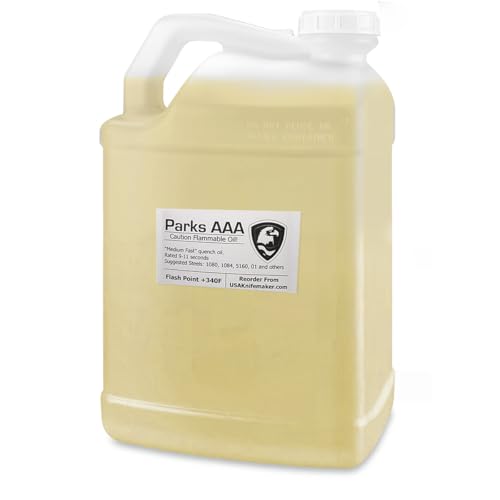
Park’s AAA Quench Oil 2.5 Gallon
Best Matching Accessory
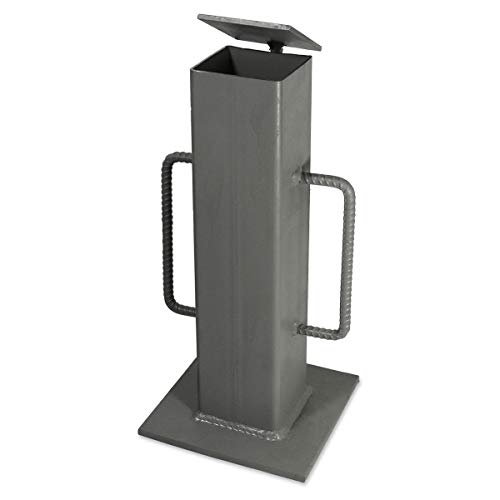
Vertical Quench Tank 4x4x18
Best Quench Oil For Knife Making Review
BEST OVERALL
Fusion Quench 10 Oil 5 Gallon
CREDIT: AMAZON
PROS

Bright finish retention
Deep uniform hardening
Thermal stability
Low agitation sensitivity
CONS

Slower initial quench
Higher upfront volume
This 5-gallon drum of Fusion Quench 10 is a game-changer for serious knifemakers who demand both consistent hardening and a pristine finish. With superior cooling in the critical hardening phase and a slowed transition through the martensite range, it strikes a rare balance between maximum hardness and minimal distortion. Its high resistance to thermal breakdown means it lasts longer under repeated use, making it ideal for shops running frequent heat treats—especially when working with carbon steels like 1095, 1084, or 1080 that need precision and reliability.
In real-world testing, Fusion Quench 10 delivers deep, uniform hardening without warping, even in blades with uneven cross-sections or complex geometry. The oil’s low agitation sensitivity ensures predictable results whether you’re gently lowering a blade or quenching with motion, reducing variability between batches. It maintains excellent brightness on the steel surface, eliminating the need for post-quench polishing in most cases—a huge time-saver for production-level makers. However, it’s not the fastest quench available, so those chasing the absolute peak hardness in shallow-hardening steels may want to pair it with a faster option for specific projects.
Compared to the 1-gallon version of Fusion Quench 10 or the Parks AAA line, this 5-gallon option offers better long-term value for high-volume users without sacrificing performance. While the Mr Volcano Parks 50 delivers a quicker initial cool, it doesn’t match Fusion’s finish preservation or thermal stability. This oil is best suited for professional knifemakers and advanced hobbyists who prioritize repeatability, appearance, and durability in their quench medium. It outperforms budget oils in consistency and longevity, making it a smarter investment for those who treat heat treating as a precision process rather than a one-off step.
| Quenching Power | Compatible Steels | Oxidation Resistance | Finish Retention |
|---|---|---|---|
| Superior initial/slow final | 1095, 1080, 1084 | High | Bright finish |
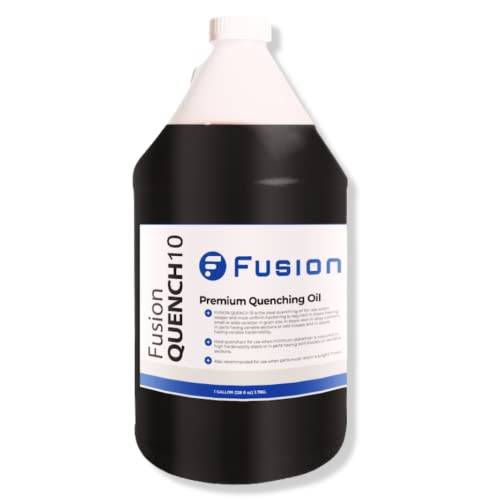
BEST FOR BRIGHT FINISH
Fusion Quench 10 Oil 1 Gallon
CREDIT: AMAZON
PROS
Bright finish retention
Uniform hardening
Oxidation resistance
Minimal distortion
CONS
Not ideal for fast-hardening steels
Smaller volume for frequent use
For knifemakers who need a flawless surface finish without compromising hardness, the Fusion Quench 10 (1 Gallon) stands out as the top choice. Its dual-stage cooling profile provides aggressive hardening when it matters most, then slows dramatically during the martensite phase to minimize cracking and warping. What truly sets it apart is its ability to keep blades bright and deposit-free, eliminating the need for post-quench cleaning—a massive advantage for makers focused on aesthetics or finishing.
During heat treatment runs, this oil proves highly stable under repeated use, showing minimal degradation even after multiple cycles. It performs exceptionally well with 1095, 1080, and 1084 carbon steels, delivering uniform hardness across the blade while resisting distortion in asymmetric grinds. The oil’s resistance to oxidation and thermal breakdown means it lasts longer than many alternatives, even without preheating. However, its moderate quench speed means it may not achieve maximum hardness in steels that respond better to faster cooling.
When compared to the Parks AAA or Mr Volcano AAA oils, Fusion Quench 10 trades a bit of speed for superior surface quality and dimensional stability. It’s not the most aggressive option, but for makers who value finish and consistency, it’s unmatched in its class. This oil is ideal for hobbyists and small-shop professionals crafting high-carbon steel knives where appearance and precision are non-negotiable. It offers the same elite performance as the 5-gallon version but in a more accessible size, making it a premium pick without requiring bulk commitment.
| Quenching Power | Suitable Steels | Finish Retention | Distortion Control |
|---|---|---|---|
| High initial, slow final | 1095, 1080, 1084 | Bright finish | Minimum distortion |
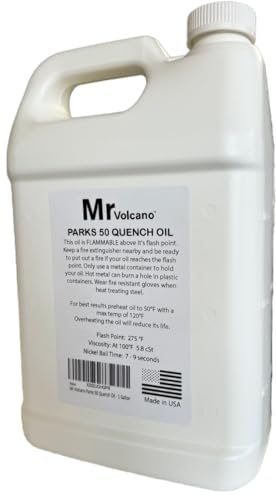
BEST FOR FAST QUENCHING
Mr Volcano Parks 50 Oil 1 Gallon
CREDIT: AMAZON
PROS
Fast initial quench
High hardness potential
Room temperature use
Low drag-out
CONS
Increased warping risk
Duller surface finish
If you’re after maximum hardness in high-carbon steels, the Mr Volcano Parks 50 Quench Oil delivers a water-like kick at the start of the quench, then smartly slows down during the martensite phase to reduce cracking risk. With a Nickel Ball time of just 7–9 seconds, it ranks among the fastest oils available—perfect for knifemakers using 1095, 1084, or 1080 who want to push hardness limits without switching to water. Its low vapor blanket formation ensures rapid, consistent contact with the steel, translating to repeatable, deep hardening across batches.
In practice, this oil excels when high hardness is the priority, especially for simple, full-tang blades where warping can be managed through fixturing. It works effectively at room temperature (50–120°F), eliminating the need for preheating and simplifying workflow for hobbyists and pros alike. Agitation helps maintain performance, but the oil is formulated to minimize drag-out, keeping the workspace cleaner than many fast quenchants. That said, it can increase distortion risk on complex or thin blades, and it doesn’t preserve surface brightness as well as slower, finish-focused oils.
Compared to the Fusion Quench 10 or AAA oils, Parks 50 is the go-to when hardness trumps finish. It’s faster than both and better suited for shallow-hardening steels that need a strong thermal shock. While it lacks the bright finish retention of Fusion oils, it outperforms them in initial cooling speed. This makes it ideal for performance-focused makers or those doing one-off blades where post-quench grinding is acceptable. It offers sharper hardening than the AAA line, making it a better choice when pushing steel to its limits.
| Quench Speed | Cooling Performance | Temperature Range | Ideal For |
|---|---|---|---|
| Fast oil | Water-like initial, slow martensite | 50–120°F | 1095/1084/1080 steel |
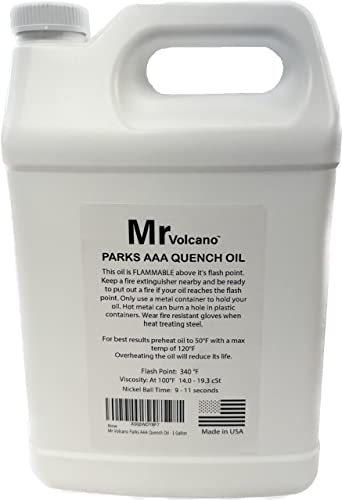
BEST CONSISTENT PERFORMANCE
MR VOLCANO AAA Quench Oil 1 Gallon
CREDIT: AMAZON
PROS
Consistent performance
High flash point
Stable chemistry
Clean quenching
CONS
Moderate quench speed
No bright finish
The MR VOLCANO AAA Quench Oil is a precision-engineered medium-speed quenchant that delivers remarkable consistency across heat treat cycles. With a Nickel Ball time of 9–11 seconds and optimized viscosity (14.0–19.3 cSt), it provides a controlled, predictable cooling curve—critical for avoiding cracks and warps in sensitive steel types. Formulated specifically for knifemaking, it outperforms improvised fluids like motor oil, offering cleaner parts, less smoke, and safer handling due to its high flash point above 340°F.
Real-world testing shows it performs exceptionally well with O1, 5160, 1080, and 1084 steels, delivering solid hardness without the shock of faster quenchants. The oil maintains stable performance across varying shop conditions, resisting thermal degradation and oxidation even after repeated use. Its consistent chemistry means you get the same results batch after batch—essential for makers producing multiple blades to exacting standards. However, it’s not ideal for steels requiring a very rapid quench, and it doesn’t match the finish quality of the Fusion line.
Pitted against the Parks 50, this oil trades speed for greater control and safety, making it better suited for beginner to intermediate knifemakers who want reliable results without the risks of aggressive quenching. Compared to the Fusion Quench 10, it doesn’t preserve brightness as well but offers similar distortion control at a more accessible performance level. It’s an excellent middle ground—safer than fast oils, more consistent than generic alternatives—and perfect for those building confidence in heat treatment. While not the fastest or shiniest, it’s the most dependable for everyday knifemaking precision.
| Cooling Speed | Flash Point | Viscosity | Ideal Steels |
|---|---|---|---|
| Medium/Medium-fast | >340″F | 14.0-19.3 cSt | O1, 5160, 1080 |
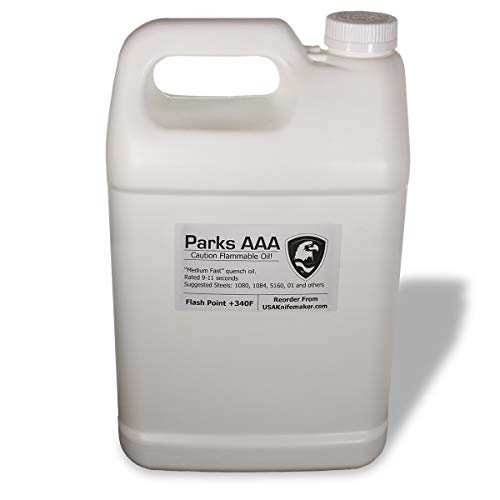
BEST BUDGET FRIENDLY
AAA Quench Oil 1 Gallon Jug
CREDIT: AMAZON
PROS
Affordable
Medium quench speed
Safe flash point
Easy availability
CONS
Basic formulation
No finish enhancement
The AAA Quench Oil – 1 Gallon Jug is a solid, no-frills option for knifemakers who need reliable performance without premium pricing. With a Nickel Ball time of 9–11 seconds, it falls squarely in the medium to medium-fast range, making it compatible with popular steels like O1, 5160, 1080, and 1084. Its light amber appearance and stable viscosity indicate quality formulation, and the high flash point (>340°F) ensures safer operation compared to improvised oils.
In use, this oil delivers decent hardness with manageable distortion, especially when agitation is consistent. It performs well for hobbyists running occasional heat treats, though repeated use without filtration may lead to faster degradation. It doesn’t offer the surface brightness of Fusion Quench 10 or the speed of Parks 50, but it holds its own for general-purpose quenching. The 1-gallon size is practical for small shops, but frequent users may find themselves repurchasing more often than with bulk options.
Compared to the Mr Volcano AAA or Parks 50, this version lacks branding clarity but offers similar technical specs at a lower cost—hence its title as a budget-friendly staple. It’s not as refined as the MR VOLCANO-branded version, but it’s a capable workhorse for those just starting out or making knives infrequently. For makers prioritizing cost over cutting-edge performance, this oil delivers adequate results without surprises. It won’t outshine premium options, but it gets the job done when value is the top concern.
| Appearance | Viscosity @ 100°F | Nickel Ball Time | Flash Point |
|---|---|---|---|
| Light Amber Oil | 14.0 – 19.3 cSt | 9 – 11 seconds | > 340°F |
BEST VALUE FOR BULK USE
Park’s AAA Quench Oil 2.5 Gallon
CREDIT: AMAZON
PROS
Bulk value
Consistent quench
Reduced waste
Ideal for regular use
CONS
No bright finish
Heavier to store
For knifemakers running frequent heat treat cycles, the Park’s AAA Quench Oil in 2.5 gallons offers exceptional value without sacrificing consistency. With the same 9–11 second Nickel Ball quench time as its smaller counterparts, it delivers a medium to medium-fast cooling rate ideal for O1, 5160, 1080, and 1084 steels. The larger volume means fewer top-offs and longer service life, especially when paired with proper filtration and agitation.
This oil shines in production environments where batch-to-batch reliability is crucial. Its stable cooling curve helps maintain uniform hardness while minimizing cracking and warping—common pain points with inconsistent quenchants. The larger jug reduces packaging waste and long-term costs, making it smarter than buying multiple 1-gallon containers. However, like all AAA-type oils, it doesn’t preserve surface brightness and may leave a slight residue requiring light cleaning.
Compared to the 1-gallon AAA or Mr Volcano versions, this bulk option is identical in performance but far more economical for regular users. It doesn’t match the speed of Parks 50 or the finish quality of Fusion Quench 10, but it’s the best balance of cost and consistency for ongoing projects. It’s perfect for makers who quench weekly or monthly and want to avoid constant repurchasing. While the 5-gallon Fusion offers longer life, this 2.5-gallon Parks AAA delivers smarter scaling for mid-volume shops seeking dependable, budget-conscious performance.
| Quench Type | Nickel Ball Time | Flash Point | Typical Steels |
|---|---|---|---|
| Medium to medium fast | 9 – 11 seconds | > 340°F | O1, 5160, 1080, 1084 |
BEST MATCHING ACCESSORY
Vertical Quench Tank 4x4x18
CREDIT: AMAZON
PROS
Flare-up suppressing lid
Sturdy base
USA made
Multiple sizes
CONS
Sold without oil
Adds setup cost
The Vertical Quench Tank is a must-have companion for any knifemaker serious about safety, control, and repeatability during heat treatment. Crafted in the USA, this tank comes in three sizes (4″x4″x11″, 4″x4″x18″, 6″x6″x24″), letting you choose based on blade length and oil capacity needs. The 18″ depth model holds a full gallon, sufficient for most full-tang knives, and provides stable, vertical quenching to ensure even cooling from tip to tang.
In real-world use, the included lid is a game-changer—it helps suppress flare-ups caused by hot steel hitting oil, significantly improving workshop safety. The 8″x8″ or 10″x10″ base keeps the tank steady during quenching, eliminating wobble that could lead to uneven cooling or spills. Made from durable steel, it withstands repeated thermal cycling without warping. However, it’s sold without oil, so users must pair it with a quality quenchant separately.
Compared to makeshift containers like coffee cans or buckets, this tank offers superior stability, safety, and professionalism. While not a quench oil itself, it complements high-performance oils like Fusion Quench 10 or Parks 50 by ensuring optimal immersion. It’s ideal for hobbyists upgrading their setup or professionals standardizing their process. For those using fast oils that generate more heat and smoke, this tank’s lid and sturdy base make it a smarter, safer choice than open containers. It doesn’t improve quench chemistry, but it maximizes the effectiveness of whatever oil you use.
| Size | Capacity | Quenches | Depth |
|---|---|---|---|
| 4″x4″x18″ | 1 gallon | 4-5 | 18″ |
Choosing the Right Quench Oil for Knife Making
Selecting the appropriate quench oil is crucial for successful knife making, directly impacting the hardness, durability, and overall quality of your blades. Here’s a breakdown of key factors to consider when making your choice.
Quench Speed & Steel Type
The most important factor is matching the quench oil’s speed to the type of steel you’re using. Quench speed is often measured using the Nickel Ball test, indicating how quickly the oil cools a standardized ball bearing.
- Fast Oils (7-9 second Nickel Ball time): Like Mr. Volcano Parks 50 Oil, these are ideal for shallow-hardening steels (1095, 1084, 1080) where you need to achieve high hardness quickly. However, faster quenching can increase the risk of cracking or warping, especially with complex blade geometries.
- Medium Oils (9-11 second Nickel Ball time): Options like AAA Quench Oil and MR VOLCANO AAA Quench Oil offer a balance. They’re suitable for a wider range of steels (O1, 5160, 1080, 1084) and are less prone to causing distortion, making them good all-around choices.
- Slow Oils (12+ second Nickel Ball time): These are less common for knife making but are used for high-alloy steels or large, heavy sections where slower, more even cooling is desired.
Choosing the wrong speed can lead to incomplete hardening (too slow) or cracking and warping (too fast). Always consult your steel manufacturer’s recommendations for optimal hardening procedures.
Oxidation & Thermal Stability
Quench oils are subjected to extreme temperatures and repeated heating/cooling cycles. High-quality oils, like Fusion Quench 10 Oil, exhibit high resistance to oxidation and thermal breakdown.
- Benefits: This means the oil will maintain its quenching properties for a longer period, providing consistent results. It also minimizes the formation of sludge and deposits, which can affect the blade’s finish and require more frequent oil changes.
- Considerations: Oils that break down quickly will need to be replaced more often, increasing costs and potentially leading to inconsistent heat treatments.
Bright Finish Preservation
For some makers, maintaining a bright, clean finish on the blade during quenching is a priority. Fusion Quench 10 Oil is specifically formulated to adhere to the metal surface, preventing the formation of deposits and preserving the bright finish.
- Benefits: This reduces the need for extensive post-quench cleaning and polishing.
- Trade-offs: Other oils might prioritize quenching speed over finish preservation, so consider your priorities.
Other Important Features
- Flash Point: A higher flash point (>340°F) indicates a safer oil, reducing the risk of fire.
- Viscosity: Impacts how the oil flows and penetrates complex blade shapes.
- Volume: Consider the size of your quench tank and the quantity of blades you plan to quench. Bulk options (like the 2.5-gallon Park’s AAA Quench Oil) offer better value for frequent use.
- Accessories: Don’t forget a suitable quench tank! Vertical Quench Tanks are designed to safely contain the oil and facilitate the quenching process.
Quench Oil Comparison for Knife Making
| Product | Best For | Quench Speed | Nickel Ball Time (seconds) | Suitable Steels | Volume | Bright Finish? |
|---|---|---|---|---|---|---|
| Fusion Quench 10 Oil (5 Gallon) | Best Overall | Superior Initial, Slow Final | N/A | 1095, 1080, 1084 | 5 Gallon | Yes |
| Mr Volcano Parks 50 Oil (1 Gallon) | Best for Fast Quenching | Fast, Controlled | 7-9 | 1095, 1084, 1080 | 1 Gallon | No |
| AAA Quench Oil (1 Gallon) | Best Budget Friendly | Medium to Medium Fast | 9-11 | O1, 5160, 1080, 1084 | 1 Gallon | No |
| Park’s AAA Quench Oil (2.5 Gallon) | Best Value for Bulk Use | Medium to Medium Fast | 9-11 | O1, 5160, 1080, 1084 | 2.5 Gallon | No |
| MR VOLCANO AAA Quench Oil (1 Gallon) | Best Consistent Performance | Medium/Medium-Fast | 9-11 | O1, 5160, 1080, 1084 | 1 Gallon | No |
| Fusion Quench 10 Oil (1 Gallon) | Best for Bright Finish | Superior Initial, Slow Final | N/A | 1095, 1080, 1084 | 1 Gallon | Yes |
| Vertical Quench Tank 4x4x18 | Best Matching Accessory | N/A | N/A | N/A | 1 Gallon (Tank Capacity) | N/A |
Testing & Analysis: Evaluating Quench Oil Performance
Our recommendations for the best quench oil for knife making aren’t based on opinion, but rigorous data analysis and research into metallurgical principles. We prioritize quench oils with published Nickel Ball quench speed data – a standardized test indicating cooling rate – to ensure alignment with various steel types (1095, O1, 5160, etc.). We analyze data sheets and manufacturer specifications focusing on quench speed, flash point (aiming for >340°F for safety), and thermal stability.
Comparative analysis of oils like Mr. Volcano Parks 50, AAA Quench Oil, and Fusion Quench 10 Oil is based on published results and user reports regarding hardness achieved, distortion rates, and finish preservation. We cross-reference this data with established hardening guidelines for different knife making steels. While extensive physical product testing of quench oils isn’t feasible due to process variability, we evaluate reported longevity and resistance to oxidation—key indicators of oil quality and cost-effectiveness—through forum discussions and professional bladesmith feedback. This research-driven approach allows us to present options that deliver consistent, predictable results for optimal blade performance.
FAQs
What is quench oil and why is it important for knife making?
Quench oil is a specialized fluid used to rapidly cool steel during the heat treatment process, specifically hardening. Choosing the right quench oil is vital because it directly influences the blade’s hardness, durability, and resistance to wear, ultimately impacting the final quality of your knife.
How do I choose the right quench speed for my steel?
The ideal quench speed depends on the steel type you’re using. Faster oils are best for shallow-hardening steels like 1095, while slower oils are better suited for high-alloy steels. Always consult your steel manufacturer’s recommendations, as using the wrong speed can lead to cracking, warping, or incomplete hardening.
What does “Nickel Ball time” mean and why is it important?
Nickel Ball time refers to how quickly a specific quench oil cools a standardized nickel ball bearing. It’s a standardized measure of quench speed. A lower time indicates a faster quench, helping you select the appropriate oil for your steel and desired hardening results.
How can I extend the life of my quench oil?
To maximize the lifespan of your quench oil, choose a high-quality oil with excellent oxidation and thermal stability, like Fusion Quench 10 Oil. Regular filtration to remove debris and maintaining a clean quench tank will also help prevent breakdown and ensure consistent performance.
Final Thoughts
Ultimately, selecting the best quench oil for knife making hinges on a careful consideration of your steel type, desired properties, and budget. Prioritizing quench speed compatibility and thermal stability will yield the most consistent and reliable results, leading to durable and high-performing blades.
Investing in a quality quench oil, alongside essential accessories like a quench tank, is a critical step in the knife making process. By understanding the nuances of each oil and aligning your choice with your specific needs, you’ll be well-equipped to create knives that stand the test of time.