You’re walking alone at night when a stranger blocks your path, eyes locked, hands clenched. Your heart races. You feel the familiar shape of your pocketknife—should you deploy it? The answer isn’t simple. Yes, you can legally use a knife for self-defense—but only under strict conditions, and with enormous risk.
Unlike a firearm, which stops threats at a distance, a knife forces you into close combat—within arm’s reach—where you’ll likely be grabbed, tackled, or cut. Worse, a knife is legally classified as a deadly weapon in most jurisdictions, meaning its use constitutes lethal force. That places you under the same legal microscope as someone who fired a gun. Even if you’re justified, expect arrest, prosecution, and a long legal battle.
The reality is harsh: knives are high-risk, last-resort tools. Their effectiveness hinges almost entirely on training, mindset, and the ability to make split-second decisions under extreme stress. Without preparation, a knife may be taken from you—or used against you.
This guide breaks down the legal realities, tactical truths, training demands, and safer alternatives so you can decide whether carrying a knife for self-defense is a responsible choice—or a dangerous gamble.
Knives Are Legally Deadly Weapons
Lethal Force Applies to All Knives
Under U.S. law, any knife—no matter the size—can be classified as a deadly weapon. According to the Code of Federal Regulations (10 CFR 1047.7), deadly force is any action “capable of causing death or serious bodily harm.” Knives meet this standard, which means using one in self-defense is treated like using a firearm: lethal force with all its legal consequences.
Even a small pocketknife used to slash an attacker’s hand can lead to criminal charges. Courts don’t care if it was a Swiss Army knife or a tactical folder—once blood is drawn, the burden shifts to you to prove your actions were justified.
When Knife Use Is Legally Justified
To lawfully use a knife, you must meet five legal criteria:
- Imminence: The threat must be immediate—not a vague fear or future possibility.
- Proportionality: Your response must match the threat. Drawing a knife over a shove is excessive.
- Necessity: You must have no safe way to escape.
- Reasonableness: A reasonable person would believe force was necessary.
- No Provocation: You didn’t start the fight.
Example: An attacker lunges at you with a bat? You may be justified in drawing your knife. But if someone insults you and shoves you lightly, pulling a blade is not self-defense—it’s assault.
State Laws Vary Widely
There is no national standard. Knife laws differ drastically by state and city:
- Stand Your Ground states (e.g., Florida, Texas): No duty to retreat before using deadly force.
- Duty to Retreat states (e.g., New York, Wisconsin): You must attempt to flee if safe.
- Castle Doctrine states: Allow deadly force in your home without retreating.
Carrying a switchblade, gravity knife, or balisong might be legal in Arizona but a felony in New York. Ignorance is no defense—one wrong carry decision can lead to arrest or a criminal record.
Where Knives Are Banned
Even if legal to carry, knives are prohibited in:
– Schools and college campuses
– Federal buildings and courthouses
– Airports (past security)
– Public transit hubs
– Polling places
Violating these rules—even without using the knife—can result in serious penalties.
Legal Risks Exceed Those of Firearms

Prosecutors Scrutinize Knife Cases Heavily
If you stab someone in self-defense, expect to be arrested first and questioned later. Unlike gunfights—where law enforcement may quickly recognize self-defense—knife attacks are often presumed criminal.
Quote from Steven288 (Retired Detective): “Shoot someone in self-defense and most detectives will guide the case in that direction. Stab someone, and you go to jail first.”
Knives are associated with premeditation, gang violence, or uncontrolled rage. Multiple stab wounds—even in a justified case—can trigger murder charges.
Insurance May Not Cover You
Organizations like USCCA offer legal protection, but knife cases are high-risk. Coverage depends on proving your force was objectively justified. Even with insurance:
– You may face criminal charges
– Legal battles can last months or years
– You’ll need to prove your training and intent
You’ll Face Public and Judicial Bias
Juries react emotionally. Saying “I stabbed him” sounds more violent than “I shot in defense.” The visceral nature of knife wounds—blood, multiple cuts—can sway judges and jurors, regardless of the law.
Reality check: You might be legally justified—but still lose your job, freedom, or reputation.
Knives Require Extreme Close Combat
You Must Be Within Arm’s Reach
A knife is only effective within 0 to 3 feet. That means:
– You’ll smell the attacker’s breath
– You may be grabbed, tackled, or disarmed
– You’re exposed to punches, kicks, or weapons
Unlike a gun, which stops threats from yards away, a knife forces you into a physical struggle—a dangerous gamble.
Psychological and Physical Toll Is High
Knife combat is chaotic:
– Blood sprays
– Screams fill the air
– Adrenaline masks pain
Even trained individuals can freeze. And if the attacker is high on drugs or mentally unstable, they may not feel pain—rendering psychological stops useless.
Expect to Get Cut
There’s a saying: “If you fight with a knife, you will get cut.” Even experts get injured. Training must include:
– Fighting through pain
– Maintaining grip under stress
– Avoiding self-inflicted wounds
Skill Determines Survival
Untrained Use Is Dangerous
A knife in untrained hands is a liability. Without training:
– Deployment is slow
– Strikes are ineffective
– You’re vulnerable to disarms
– You risk cutting yourself
Unlike a gun, which can stop a threat with one shot, a knife requires precision, speed, and control.
Training Builds Critical Skills
Effective knife defense requires mastery of:
– One-handed draw under stress
– Blade awareness (knowing where the edge is)
– Footwork and body positioning
– Retention techniques to prevent disarming
– Stress inoculation through live drills
Quote: “Knife fighting is VERY fast and VERY dirty and there aren’t any time-outs or do-overs.” — Alan158
Recommended Training Programs
Avoid YouTube. Seek certified instructors:
– Craig Douglas (SouthNarc): Real-world, scenario-based defense
– Shivworks: Focus on retention and grappling
– Filipino Martial Arts (Kali, Eskrima): Centuries-old systems
– Aaron Janetti: Urban defense and weapon retention
Use rubber or plastic training knives to spar safely.
Fixed vs. Folding Knives: Which Is Better?
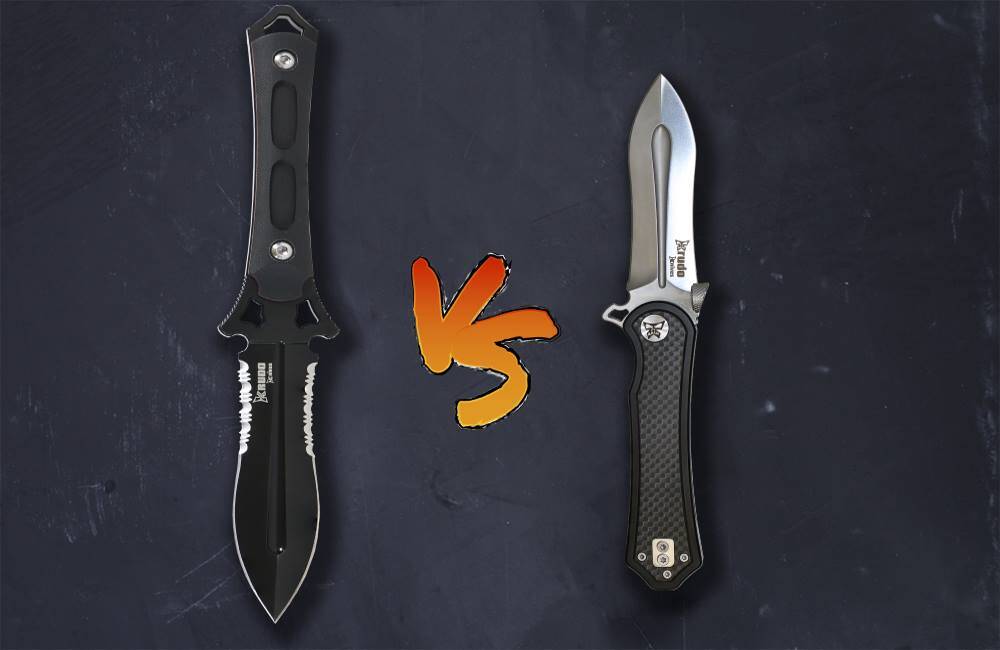
Fixed-Blade Knives for High-Risk Carry
Pros:
– No moving parts = reliable
– Full tang = strong
– Easier to maintain
Cons:
– Hard to conceal
– Requires a sheath
– Draws attention
Best for: Outdoor, tactical, rural use
Ideal blade: 3–6 inches
Folding Knives for Everyday Carry (EDC)
Pros:
– Fits in pocket
– Easy to conceal
– Less suspicious
Cons:
– Mechanical failure risk
– Slower deployment
– Shorter blade (2–4 inches)
Must-have features:
– One-handed opening (thumb stud, flipper)
– Secure lock (frame or liner)
– Deep-carry clip
– Tapered tip for piercing
Best for: Urban carry, legal compliance
Tactical Use: Targets and Techniques

Goal Is Escape, Not Victory
Your objective isn’t to “win”—it’s to:
– Create distance
– Disrupt the attack
– Escape or draw a firearm
Use short, rapid strikes, then disengage immediately.
Best Target Areas
| Target | Effect |
|---|---|
| Hands/Forearms | “Defangs the snake”—disables weapon grip |
| Thighs (Femoral Artery) | Rapid blood loss, impairs mobility |
| Groin | Painful, reduces aggression |
| Neck (Carotid/Trachea) | High-risk, high-reward—only for extreme threats |
Avoid overcommitting. One good strike beats multiple wild stabs.
The Hip Jab Technique
Keep the knife close to your hip, not extended. Use a short upward jab like a piston:
– Protects your elbow
– Maintains balance
– Allows quick retraction
– Enables follow-up
De-Escalation Beats Combat
A Knife Can Deter Without Being Used
Simply displaying a knife with confident posture and a firm command like “I’m armed—back off!” can stop an attack.
Real case: Burdo avoided a robbery by showing a large knife and issuing a clear warning.
Use Verbal and Visual Deterrence
- Verbal: “Stop. I have a knife. Leave now.”
- Visual: Draw slowly, blade visible but not pointed
- Posture: Stand firm, eyes locked, weapon controlled
The goal is to make the attacker reconsider, not provoke a fight.
Avoid the Fight Altogether
Quote: “The best fight is the one avoided.” — Article 6
Prioritize:
– Situational awareness
– De-escalation skills
– Escape routes
– Group travel
A well-timed retreat is smarter than a risky confrontation.
Safer Alternatives Exist
Non-Lethal Options Are Often Better
| Tool | Why It’s Safer |
|---|---|
| Pepper Spray | Works at 6–10 feet, minimal training |
| Stun Gun | Stops attackers temporarily |
| Tactical Pen | Discreet, effective for eye strikes |
| Personal Alarm | Draws attention, scares off attackers |
These tools let you defend without crossing into lethal force.
Non-Weapon Strategies Matter Most
- Stay alert: Avoid distractions
- Trust your gut: If it feels wrong, leave
- Use lighting and crowds
- Carry with confidence: Posture prevents confrontation
Final Recommendations
If You Carry a Knife, Follow These Rules
- Choose wisely: Folding for EDC, fixed-blade for tactical
- Carry accessibly: Appendix or belt carry
- Train relentlessly: Attend real courses
- Know your laws: Understand local rules
- Maintain your gear: Keep blade sharp
- Document training: Save certificates
- Use as last resort: Only when escape fails
Be Realistic About Effectiveness
Quote: “For most people, reaching for the knife means the firearm has failed… a choice between certain death and probable jail.” — Alexander8
A knife is better than nothing, but inferior to a gun or non-lethal tools. It’s a “get-off-me” tool, not a primary equalizer.
Summary: Key Takeaways
- ✅ Yes, you can use a knife—but only against imminent, life-threatening attacks.
- ⚖️ Knives are deadly weapons—using one invokes lethal force laws.
- 🏛️ Legal justification requires imminence, proportionality, necessity, and reasonableness.
- ⚠️ Even if justified, expect arrest, prosecution, and intense scrutiny.
- 🥷 Knife fights happen at arm’s length—you will likely get cut.
- 🎯 Effectiveness depends on training, not the tool.
- 🛑 De-escalation and escape are safer than combat.
- 🌿 Pepper spray, awareness, and avoidance are often better choices.
Bottom line: A knife can save your life—but it can also ruin it. Carry responsibly, train rigorously, and use it only when all other options are gone.