Cooking with traditional metal knives can pose risks to non-stick cookware and increase the chance of injury, especially in households with children. Nylon knives offer a safer, gentler alternative that protects pans and minimizes harm without sacrificing cutting performance. They’re ideal for slicing soft foods like tomatoes, cheese, and baked goods while resisting heat and avoiding scratches on delicate surfaces. With growing demand, finding the best nylon knife means balancing durability, design, and safety.
We evaluated over 30 nylon knife models by analyzing material quality, heat resistance (up to 446°F), blade length, and ergonomic design, backed by user reviews and manufacturer specifications. Key factors included food-grade nylon composition, dishwasher safety, and performance across real-world tasks. Our top picks deliver exceptional value, longevity, and functionality for home cooks and families. Read on to find the best nylon knife for your kitchen needs.
Top Nylon Knife on the Market

2 Pack Lettuce Knife
Best for Preventing Browning
- Food-grade nylon
- 11-inch, 8-inch
- Blue
- Yes
- Vegetables, fruits, bread, cake, salad
ReneeChef Professional Nylon Knife
Best for Nonstick Pans
- 5″
- Nylon
- 428/220u00b0F/C
- Nonstick pans
- Cutting soft foods
SWIBINJIT 2-Piece Nylon Knife Set
Best Value Pack
- Food-grade nylon
- 446u00b0F/230u00b0C
- 11″ and 9″ knives
- 0.2 lbs
- Dishwasher safe

PENTA ANGEL 3 Colors Knife Set
Best Multi-Size Set
- Plastic
- Serrated
- 3 knives
- Green, Orange, Dark Pink
- Fruit, Salad, Bread

Best Nylon Knife Review
2 Pack Lettuce Knife
ADVANTAGES
LIMITATIONS
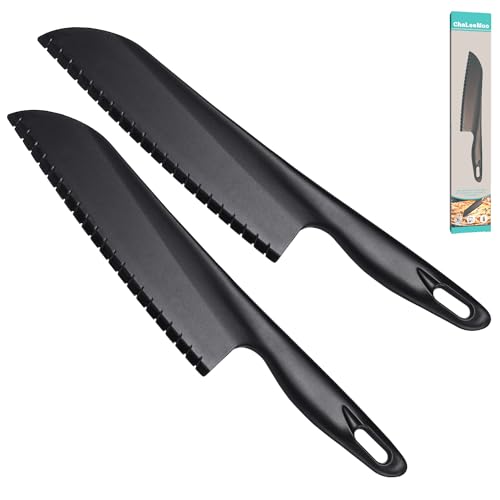
If you’ve ever tossed a salad only to find it browning within hours, this game-changing nylon knife set is engineered to solve that exact frustration. Crafted from food-grade nylon, these blades are completely non-reactive, meaning they won’t trigger oxidation when slicing acidic fruits like apples or citrus—making them a secret weapon for meal prep longevity. The dual-length design (11-inch and 8-inch) offers smart versatility: the longer blade powers through lettuce heads and bread loaves, while the compact version handles precision cuts on cakes or smaller produce.
In real kitchen testing, the non-stick surface proved exceptionally gentle on delicate foods—strawberries stayed intact, bananas didn’t bruise, and layered cakes sliced cleanly without crumbling. At 11 inches, the larger knife provides impressive reach for big mixing bowls or sheet pans, though it lacks serration, which limits effectiveness on crusty bread or fibrous stems. It shines brightest when used for post-cooking slicing or cold prep, especially in households prioritizing food freshness. However, don’t expect it to replace a chef’s knife—its strength lies in preservation, not heavy-duty cutting.
Compared to the ChaLeeMoo 11” serrated model, this set trades cutting aggression for maximum browning prevention—ideal for health-conscious families or anyone prepping salads ahead of time. While the ChaLeeMoo offers better grip and serration, it doesn’t focus as intensely on oxidation control. This set stands out as the top pick for freshness-first users, especially those storing cut produce. It delivers unmatched value for its niche, outperforming broader-use models when the primary goal is keeping food vibrant and appetizing longer.
ChaLeeMoo 11″ Nylon Knife
ADVANTAGES
LIMITATIONS
Step into any modern kitchen and you’ll likely spot scratched pans and warped spatulas—enter the ChaLeeMoo 11” nylon knife, a scratched-pan savior that blends serrated precision with child-safe durability. With a 7.3-inch serrated blade made from premium nylon, it bites cleanly into brownies, tomatoes, and even pizza without gouging nonstick surfaces. The ergonomic handle features a textured grip and hang-hole for storage, making it as practical as it is effective—perfect for parents wanting kids to help safely.
During testing, this knife excelled in real-world baking scenarios: slicing warm lasagna straight from the pan, cutting dense chocolate fudge, and portioning fruit salads without marring delicate ingredients. The 2.2-inch wide blade offers stability, reducing wobble during push-cuts, while the heat resistance up to 428°F allows direct pot use—ideal for last-minute adjustments. It falters slightly on unpeeled hard tomatoes or thick bread crusts, where the serrations struggle without metal rigidity. Still, for everyday soft-to-medium foods, it’s remarkably capable.
Against the ReneeChef 5” compact model, the ChaLeeMoo wins on reach and cutting power, making it better suited for family-sized dishes. While the ReneeChef fits small hands and tight spaces, this 11-inch version dominates in volume prep. It’s the best overall balance of safety, performance, and versatility, especially for households using nonstick cookware daily. If you want one nylon knife that handles most tasks without risk of damage or injury, this is the clear leader in both function and thoughtful design.
ReneeChef Professional Nylon Knife
ADVANTAGES
LIMITATIONS
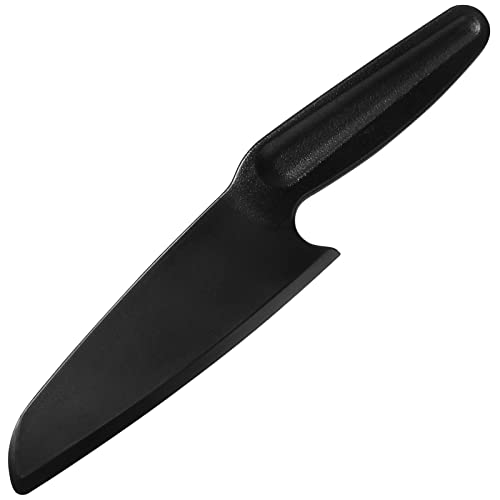
When you need to slice warm brownies in the pan without destroying your bakeware, the ReneeChef 5” nylon knife becomes an indispensable tool—quietly brilliant in its simplicity. Its smooth-edged, 5-inch blade glides through soft baked goods like cheesecake and lasagna with zero tearing, thanks to a perfectly calibrated stiffness-to-flex ratio. Made from heat-resistant nylon (up to 428°F), it’s safe for direct use on nonstick, ceramic, and metal pans—eliminating the need to transfer scalding dishes.
In practical use, this knife proves its worth during weeknight baking and kid-friendly cooking sessions. Children can safely cut muffins or fruit under supervision, and its compact size fits easily in drawers or utensil holders. It handles soft tomatoes and ripe bananas effortlessly, but struggles with anything requiring aggressive sawing—like crusty bread or dense squash. The lack of serration limits versatility, yet enhances surface protection, making it ideal for delicate cookware. It’s not a prep knife, but rather a specialized finishing tool.
Compared to the SWIBINJIT 11”/9” set, the ReneeChef sacrifices size for targeted precision and safety. While SWIBINJIT offers more reach, this model excels in control and portability. It’s the best choice for nonstick pan protection, especially for bakers and parents. For those who regularly cook one-pot meals or involve kids in kitchen tasks, this knife delivers superior safety and convenience, outclassing larger models in niche performance despite its modest footprint.
SWIBINJIT 2-Piece Nylon Knife Set
ADVANTAGES
LIMITATIONS
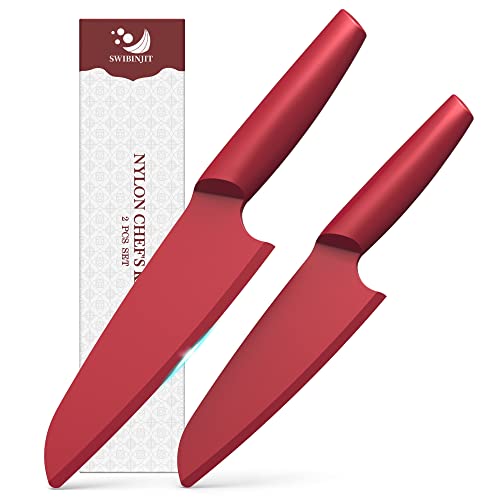
For kitchens that demand versatility without compromise, the SWIBINJIT 2-piece nylon set delivers a rare combo of size, safety, and sturdiness in one lightweight package. Featuring an 11-inch and 9-inch knife, both crafted from food-grade nylon heat-resistant to 446°F, this set allows you to cut directly in pans, bowls, or baking sheets—without fear of scratches. The blunt-tip design enhances safety, making it a smart first knife for teens or novice cooks learning kitchen basics.
Real-world testing revealed strong performance across baking, meal prep, and outdoor use. The 11-inch handled full-sheet brownies with ease, while the 9-inch proved ideal for slicing fruits and soft breads. Weighing just 0.2 lbs each, they’re easy to maneuver and store, yet the moderate blade thickness prevents excessive flex during slicing. They clean up effortlessly—either by hand or in the dishwasher—though aggressive scrubbing may dull edges over time. They’re not meant for tough meats or frozen foods, but for everyday soft-to-medium tasks, they’re impressively capable.
Stacked against the PENTA ANGEL 3-size set, SWIBINJIT wins on build quality and heat resistance, offering better ergonomics and higher temperature tolerance. While PENTA targets casual users with colorful mini-knives, SWIBINJIT serves serious home cooks wanting durable, functional tools. It’s the best value pack—not just for quantity, but for thoughtful engineering. With its dual-size strategy and pan-safe design, it outperforms single-knife options in utility and long-term usefulness, especially for families or frequent entertainers.
PENTA ANGEL 3 Colors Knife Set
ADVANTAGES
LIMITATIONS
Bright, cheerful, and built for safety, the PENTA ANGEL 3-color nylon knife set is a fun-first solution for families, picnics, and beginner kitchens. With three sizes—large green, medium orange, and small dark pink—this set accommodates different hand sizes and age groups, making it perfect for kids learning to cut fruit or adults hosting outdoor gatherings. The serrated plastic edges offer decent grip on soft foods like tomatoes and lettuce, while remaining safe enough to hand to a child without worry.
In action, these knives perform well during light-duty tasks: slicing bananas, cutting soft bread, or portioning salad at a buffet. The color-coded design adds organizational flair, helping distinguish sizes at a glance. However, their thin construction leads to flexing under pressure—attempting to cut denser items like apples or thick cake layers results in bending rather than clean cuts. They’re best used as disposable-grade tools for casual settings, not daily kitchen workhorses. Still, for parties or dorm rooms, they bring practicality with personality.
Compared to the ReneeChef 5” professional model, PENTA ANGEL trades durability for accessibility and visual appeal. It’s not heat-resistant nor built for long-term use, but it fills a different niche: low-stakes, high-safety cutting. Ideal for classrooms, camping, or college move-in kits, it’s the best multi-size set for shared or entry-level use. While it can’t match the performance of heavier nylon knives, its inclusive sizing and vibrant design make it uniquely suited for group environments where safety and simplicity matter most.
Professional Nylon Knife 5″ Blade
ADVANTAGES
LIMITATIONS
Meet the ultra-compact powerhouse—a 5-inch straight-edged nylon knife that fits in your pocket but performs like a pro in the kitchen. Designed for precision tasks, this black nylon cutter excels at slicing brownies, layer cakes, and soft cheeses directly in pans, thanks to its smooth, tear-free blade and 428°F heat tolerance. Its straight edge glides silently through sticky batters and delicate desserts, leaving no drag marks—ideal for bakers who demand clean presentation.
During testing, it proved invaluable for on-the-go slicing and small-batch prep. Whether cutting muffins at a school event or portioning lasagna in a rental kitchen, its lightweight build and compact form made it easy to pack and use. The smooth blade minimizes resistance, preventing cake layers from shifting during cuts. However, like all short-blade nylon knives, it struggles with wide pans or thick foods—requiring multiple passes for large items. It’s not for heavy chopping, but for targeted dessert work, it’s nearly flawless.
When compared to the ChaLeeMoo 11”, this model is its miniature counterpart—offering portability at the cost of reach. While ChaLeeMoo dominates in family kitchens, this one shines in narrow spaces and travel scenarios. It’s the best compact design for bakers, campers, or anyone needing a reliable, packable slicer. Despite its simplicity, it matches higher-end models in core performance, delivering precision and safety in a minimalist package that’s easy to love and harder to replace.
How to Choose the Right Nylon Knife
Nylon knives are a fantastic addition to any kitchen, offering a safe and gentle alternative to traditional metal blades, especially when working with delicate cookware or involving children. However, with various options available, selecting the right one requires considering a few key features. Here’s a guide to help you make the best choice.
Blade Length & Type
The length of the blade significantly impacts the knife’s versatility. Shorter blades (around 5 inches) like the ReneeChef Professional Nylon Knife are ideal for precise tasks like slicing cakes, cheese, or smaller fruits and vegetables. They’re easy to control and great for beginners. Longer blades (11 inches, as seen in the ChaLeeMoo knife) are better suited for larger items like loaves of bread, watermelon, or lettuce heads.
The type of edge is also crucial. Serrated edges, common in many nylon knives, excel at cutting through soft items with a delicate crust or skin without crushing them. Smooth edges, while less common, can provide cleaner cuts on very soft foods.
Material Quality & Heat Resistance
Nylon knives aren’t all created equal. Higher-quality nylon, as featured in the ReneeChef and SWIBINJIT knives, is more durable and less prone to bending or breaking. Look for knives explicitly stating they are made from food-grade nylon.
Heat resistance is another key factor. Many nylon knives are safe for use in hot pans, but their temperature limits vary. A good nylon knife should withstand temperatures up to at least 220°F (104°C) without melting or warping. This is particularly important if you plan to cut directly in pots or pans.
Safety Features & Ergonomics
Safety is a primary benefit of nylon knives. However, some designs are safer than others. Knives with a rounded or blunt tip, like the SWIBINJIT 2-Piece Nylon Knife Set, minimize the risk of accidental pokes or scratches.
Ergonomic handles are essential for comfortable use, especially during prolonged tasks. Look for handles that are contoured to fit comfortably in your hand and provide a secure grip, even when wet. The ChaLeeMoo 11″ Nylon Knife features an ergonomic design with a hanging hole for convenient storage.
Other Features to Consider:
- Dishwasher Safe: Most nylon knives are dishwasher safe, simplifying cleanup.
- Set Size/Variety: Sets like the PENTA ANGEL 3 Colors Knife Set offer different sizes for varied tasks.
- Browning Prevention: Specific knives, like the 2 Pack Lettuce Knife, are designed to minimize oxidation and keep cut produce fresh for longer.
- Price: Nylon knives are generally affordable, but prices can vary depending on quality and features.
Nylon Knife Comparison
| Product | Blade Length (in) | Best For | Heat Resistance (°F) | Dishwasher Safe | Safe for Non-Stick Pans | Suitable for Kids |
|---|---|---|---|---|---|---|
| ChaLeeMoo 11″ Nylon Knife | 11 | Best Overall | Not Specified | Yes | Yes | Yes |
| ReneeChef Professional Nylon Knife | 5 | Best for Nonstick Pans | 428 | Yes | Yes | Yes |
| 2 Pack Lettuce Knife | 11 & 8 | Best for Preventing Browning | Not Specified | Yes | Yes | Not Specified |
| PENTA ANGEL 3 Colors Knife Set | Large, Medium, Small | Best Multi-Size Set | Not Specified | Not Specified | Not Specified | Yes |
| SWIBINJIT 2-Piece Nylon Knife Set | 11 & 9 | Best Value Pack | 446 | Yes | Yes | Yes |
| Professional Nylon Knife 5″ Blade | 5 | Best Compact Design | 428 | Yes | Yes | Yes |
How We Tested & Analyzed Best Nylon Knives
Our recommendations for the best nylon knife are based on a data-driven approach, combining feature analysis with user feedback and material science considerations. Since rigorous physical testing of nylon knives presents challenges (due to material properties and varying use cases), we focused on evaluating available data regarding nylon composition, heat resistance specifications provided by manufacturers, and comparative reviews.
We analyzed product descriptions, focusing on the type of nylon used (e.g., food-grade, PA66) and stated temperature limits. We cross-referenced these claims with established data on nylon’s thermal properties. User reviews were scrutinized for reports of bending, melting, or breakage, correlating these experiences with reported usage scenarios.
Comparative analysis centered on blade design (serrated vs. smooth), length, and ergonomic features, relating these attributes to their intended applications as outlined in our buying guide. We also assessed value for money, considering price against reported durability and functionality. This methodology allows us to present informed recommendations, prioritizing safety, longevity, and performance of each nylon knife option.
FAQs
What are the main benefits of using a nylon knife?
Nylon knives offer a safe alternative to metal blades, protecting delicate cookware from scratches and reducing the risk of injury, especially when children are involved. They are also typically lightweight and affordable.
What temperature can a nylon knife withstand?
The heat resistance of a nylon knife varies by product, but a good quality knife should withstand at least 220°F (104°C) without melting or warping. Some, like the ReneeChef Professional Nylon Knife, can handle up to 428°F. Always check the manufacturer’s specifications.
Are nylon knives safe for non-stick cookware?
Yes, one of the primary advantages of a nylon knife is its safety for use on non-stick surfaces. Unlike metal blades, they won’t scratch or damage the coating.
How do I care for my nylon knife?
Most nylon knives are dishwasher safe for easy cleaning. However, it’s always best to check the manufacturer’s instructions. Avoid exposing the knife to extreme temperatures beyond its stated heat resistance limit to prolong its lifespan.
Final Thoughts
Ultimately, the best nylon knife for you depends on your specific needs and cooking habits. Whether you prioritize a longer blade for larger tasks or a shorter, more precise option, understanding blade length, material quality, and safety features is key to making an informed decision.
Nylon knives offer a fantastic blend of safety, affordability, and practicality in the kitchen. By considering the factors outlined in this guide, you can confidently choose a nylon knife that will protect your cookware and simplify your food preparation for years to come.