If you’ve ever held a KA-BAR, ESEE, or TOPS survival knife, there’s a good chance it was made from 1095 steel—a high-carbon, no-nonsense alloy that’s been trusted by military personnel, bushcrafters, and outdoor enthusiasts for over a century. Known for its razor-sharp edge, ease of sharpening, and rugged simplicity, 1095 remains a staple in hard-use fixed-blade knives.
But is it actually good—or just legendary?
The truth is nuanced. 1095 doesn’t win any awards for corrosion resistance, toughness, or long-term edge retention when stacked against modern super steels. Yet it continues to be chosen by top-tier knife makers for survival, tactical, and outdoor tools. Why?
Because 1095 excels where it counts most for real-world utility: it takes an incredibly sharp edge, holds it reasonably well, and can be brought back to razor form with almost any abrasive—even sand on a log. It’s not flashy, but it’s dependable—if made right.
This guide breaks down everything you need to know about 1095 knife steel: how it performs, why some swear by it, who should (and shouldn’t) use it, and how it stacks up against both older carbon steels and modern stainless alloys.
You’ll learn why heat treatment makes or breaks this steel, how maintenance is non-negotiable, and whether it’s still worth choosing in 2025.
What Exactly Is 1095 Steel?
A High-Carbon Workhorse
1095 is a plain carbon steel in the AISI 10xx series, where “10” means it contains no significant alloying elements beyond carbon, and “95” refers to its carbon content—approximately 0.95%, one of the highest in the 10xx family.
Its composition is simple:
– Carbon: 0.90–1.03% — enables hardness and edge retention
– Manganese: 0.30–0.50% — improves strength and hardenability
– Silicon: 0.05–0.30% — aids in deoxidizing during production
– Phosphorus & Sulfur: <0.03% — kept low to reduce brittleness
Crucially, there’s no chromium, so 1095 offers zero rust resistance. It will stain, pit, and corrode quickly if left damp or exposed to acidic materials like cardboard or citrus.
But that simplicity has advantages: it’s predictable to forge, easy to machine, and inexpensive to produce—making it ideal for budget-friendly, high-performance tools.
Edge Retention: Sharp, But Not Long-Lasting
Takes a Razor Edge—Holds It Fairly Well
When properly heat-treated, 1095 can reach 56–62 HRC, allowing it to take and maintain a very fine cutting edge. The high carbon content supports a fine grain structure, which enhances wear resistance compared to lower-carbon steels like 1060 or 1075.
In practical use, 1095 performs well for:
– Batoning hardwoods
– Slicing rope, canvas, and webbing
– Food prep and skinning
– Wood carving and feather sticking
It won’t last as long between sharpenings as S35VN, Magnacut, or D2, but it outperforms most basic steels in edge-holding—especially in survival and bushcraft settings.
Hardness Is a Double-Edged Sword
- Production knives (ESEE, TOPS): Typically hardened to 56–58 HRC for balanced edge life and toughness
- Custom blades: Often pushed to 61–62 HRC for maximum sharpness and wear resistance
But there’s a catch: the harder it is, the more brittle it becomes. A 1095 blade at 62 HRC may chip or snap under lateral stress or heavy prying. Poor heat treatment exacerbates this risk—turning a capable steel into a liability.
Toughness: Stronger in Practice Than on Paper?
Metallurgy vs. Real-World Performance
Despite its reputation for toughness, 1095 scores poorly on impact tests. Charpy results show as low as 5–10 ft-lbs at 60 HRC, worse than 1084, A2, or even 440C.
Yet users routinely report beating on ESEE and TOPS knives without failure. Why the contradiction?
Because real-world toughness depends on more than just steel chemistry:
– Blade thickness and geometry (thicker stock resists bending)
– Heat treatment quality
– Design intent (batoning vs. slicing vs. prying)
A user once snapped a Condor 1095 knife batonning a small oak. Others praise the ESEE 4 for surviving years of abuse. The difference? Manufacturing quality and design, not the steel alone.
Differential Heat Treatment: The Secret Behind Durable 1095 Knives

Hard Edge, Flexible Spine
Top makers like TOPS Knives and ESEE use differential heat treatment to overcome 1095’s brittleness:
– The cutting edge is hardened to 56–58 HRC for wear resistance
– The spine and tang remain softer and more flexible
This technique mimics traditional Japanese sword-making, creating a blade that’s hard where it needs to cut, tough where it needs to survive abuse. It’s why well-made 1095 knives feel nearly indestructible—even if the steel itself isn’t the toughest on paper.
Without this treatment, 1095 is prone to cracking under stress—especially in thick or full-tang survival knives.
Sharpening 1095: The Ultimate Field-Serviceable Steel
Sharpen It Anywhere, With Anything
This is where 1095 truly shines. It’s one of the easiest steels to sharpen in the field—even with rudimentary tools.
It responds well to:
– Diamond stones and paddles
– Silicon carbide papers
– Arkansas stones
– Leather strops with green compound
– Pocket sharpeners
– Even wet sand on a log (documented in Amazon field use)
Fast, Predictable Refinement
Users report quick sharpening cycles:
1. Form a burr with a 5-micron diamond paddle
2. Refine with 3.5-micron paste
3. Polish on a leather strop with compound
4. Optional: Add a convex micro-bevel for slicing performance
Compared to D2, VG-10, or 3G, 1095 is dramatically easier to touch up—critical when you’re miles from civilization and need a working edge fast.
Corrosion Resistance: Zero—Maintenance Is Mandatory
Will Rust Without Care
1095 has no inherent corrosion resistance. Expose it to moisture, sweat, or acidic materials, and it will rust—sometimes within hours.
Signs of neglect:
– Surface staining (gray or black spots)
– Orange flecks (early-stage rust)
– Pitting (advanced corrosion)
How to Prevent Rust
- Wipe dry after every use
- Oil regularly (mineral oil, CLP, Briwax)
- Store in a dry place
- Avoid prolonged exposure to wet environments
With consistent care, 1095 develops a protective patina—a darkened surface layer that slows future oxidation. Some users accelerate this with vinegar, mustard, or controlled exposure.
Coatings Help, But Aren’t Permanent
Manufacturers apply finishes to buy time:
– Black powder coat (ESEE)
– Parkerization (military-style)
– Tactical gray coating (TOPS)
– Epoxy layers
These help in humid climates, but they wear off with use. Users in South Florida report no rust issues—as long as they oil their blades monthly.
Heat Treatment: The Make-or-Break Factor
Quality Determines Performance
You can have perfect 1095 steel—but if it’s poorly heat-treated, it’s useless. Too hard? It chips. Too soft? The edge rolls.
Ideal hardness:
– 56–58 HRC for survival and bushcraft knives
– 61–62 HRC for custom slicers (with proper geometry)
Poor heat treatment explains why some 1095 knives fail catastrophically while others endure decades of abuse.
Oil Quenching Is Standard
Most makers use oil quenching to reduce warping and cracking risk. Water quenching cools faster but increases fracture risk—especially in thick blades.
Custom makers may use:
– Preheated canola oil for controlled cooling
– Multiple quenches for thick stock
– Partial edge quenching to harden only the edge
These techniques allow thicker blades (like survival knives or straight razors) to be fully functional without brittleness.
1095 vs. 1075: The Carbon Steel Trade-Off
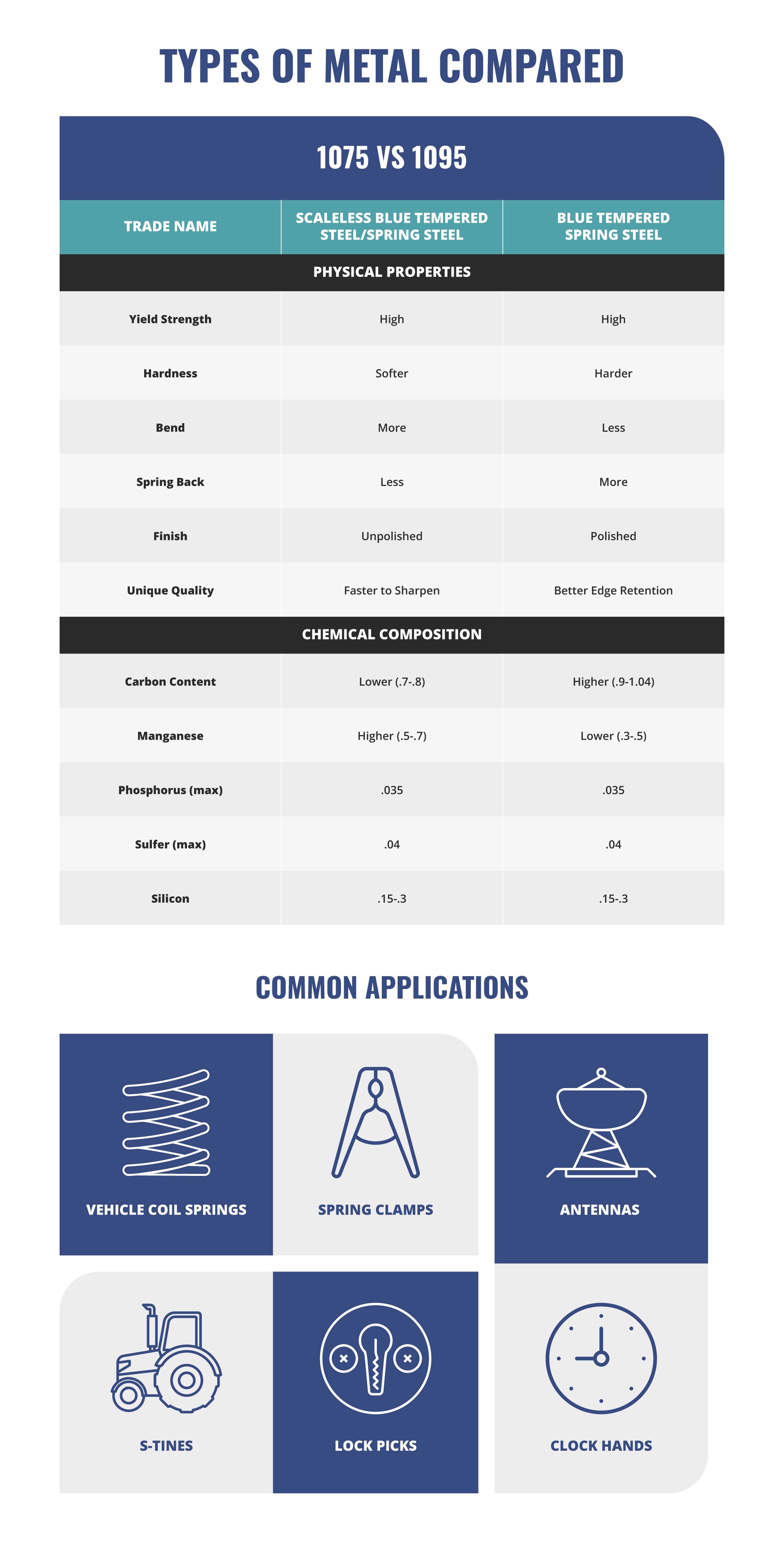
Edge Life vs. Durability
| Feature | 1095 | 1075 |
|---|---|---|
| Carbon | 0.90–1.03% | 0.75–0.80% |
| Edge Retention | Better | Moderate |
| Toughness | Lower | Higher |
| Max Hardness | 62 HRC | ~58 HRC |
| Best For | Slicing, EDC | Heavy chopping, survival |
1075 is tougher and less brittle—ideal for heavy-duty tasks. Ontario Knife Company switched from 1095 to 1075 in many models due to breakage complaints.
But 1095 holds a sharper edge longer. It’s a trade-off: precision vs. durability.
How 1095 Compares to Modern Steels
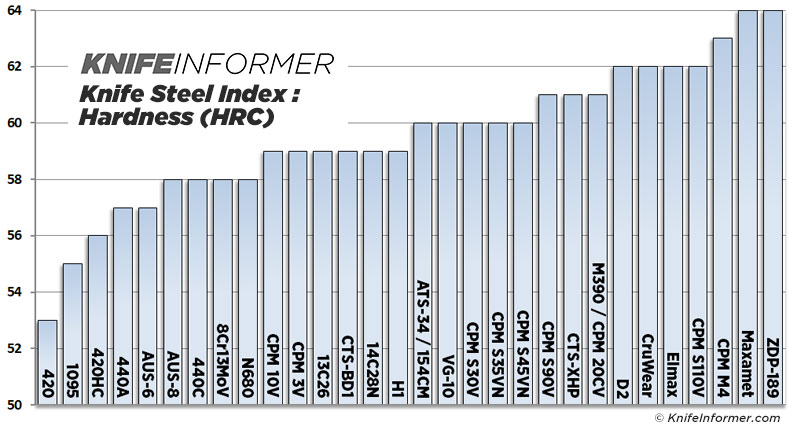
Outgunned, But Not Outclassed
| Steel | Edge Retention | Toughness | Corrosion | Sharpening |
|---|---|---|---|---|
| 1095 | Good | Moderate | None | Excellent |
| D2 | Excellent | Moderate | Low | Difficult |
| A2 | Very Good | High | None | Moderate |
| 3V | Excellent | Exceptional | None | Moderate |
| S35VN | Excellent | High | High | Moderate |
| 80CrV2 | Better | Better | None | Easy |
| 14C28N | Better | 3x tougher | High | As easy |
Steels like 80CrV2, A2, 3V, and 14C28N outperform 1095 in toughness, wear resistance, or corrosion—often at similar prices.
Yet 1095 remains popular because:
– It’s cheaper to produce
– It’s easier to sharpen in the field
– It has proven reliability in well-made knives
Who Should Use a 1095 Knife?
Ideal Users
✅ Bushcrafters and survivalists who maintain their gear
✅ Beginners learning knife care and sharpening
✅ Outdoor professionals needing a field-serviceable blade
✅ Traditionalists who value heritage and simplicity
Who Should Avoid It
❌ Urban EDC users who cut cardboard (acidic residue = rust)
❌ People who hate maintenance
❌ Wet environment users without consistent upkeep
❌ Those wanting “set it and forget it” performance
Top Brands Using 1095 Steel
ESEE: Rugged and Reliable
- Models: ESEE 3S, 4, 5, 6, Izula 2
- Features: Full tang, Micarta handles, black coating
- Heat treatment: 56–58 HRC
- Reputation: Excellent durability for survival tasks
Users praise ESEE for consistent quality and real-world toughness—thanks to solid heat treatment and thick blade stock.
TOPS Knives: Built to Last
- Philosophy: Overbuilt, USA-made tools
- Key models: Mini Scandi, Tidal Force Cleaver
- Heat treatment: Differential hardening
- Finish: Tactical gray or Parkerized
TOPS justifies using 1095 through superior processing, not just material choice.
KA-BAR: The Original
- Legacy: U.S. Marine Corps combat knife
- Steel: 1095 high-carbon
- Handle: Leather or Grivory
- Focus: Simplicity, reliability, tradition
The KA-BAR remains a symbol of rugged dependability, even if newer steels outperform it.
Final Verdict: Is 1095 Good Knife Steel?
Yes—With Conditions
1095 is not the best steel available. It’s outclassed by modern options in edge retention, toughness, and corrosion resistance. But it’s still a very good knife steel—for the right user and use case.
It excels when:
– You need a sharp, easy-to-maintain blade
– You’re willing to oil and clean it regularly
– You value affordability and tradition
– You use it for bushcraft, survival, or hard tasks
It fails when:
– It’s poorly heat-treated
– It’s used in wet or corrosive environments without care
– You expect stainless-like convenience
The Maker Matters More Than the Metal
A well-made 1095 knife from ESEE or TOPS will outperform a cheaply made one every time. Heat treatment, geometry, and finish define performance more than the steel alone.
Bottom Line
1095 is a capable, honest steel. It doesn’t hide its flaws—rust if you neglect it, chip if it’s too hard. But sharpen it, oil it, and treat it right, and it will serve you faithfully for years.
For beginners, it’s a great learning steel. For experts, it’s a respected workhorse. Not the king of steels—but a reliable soldier in the knife world.
If you want low maintenance and maximum edge life, look to S35VN or Magnacut.
If you want simplicity, sharpenability, and soul, 1095 is still a solid choice.