If you’ve ever held a vintage Case knife and wondered when it was made, you’re not alone. Fortunately, Case knives are among the easiest pocket knives to date—thanks to a meticulous, decades-long system of tang stamps. These small engravings on the blade’s base reveal not just the year of production, but also the steel type, handle material, and model. Whether you’re a new collector or verifying a family heirloom, learning how to read these stamps turns guesswork into precision.
This guide walks you through the entire evolution of Case tang stamps, decade by decade, so you can confidently identify any knife from 1920 to today. You’ll learn how to decode dots, X’s, letter styles, and pattern numbers, and avoid common dating mistakes. By the end, you’ll know exactly how to determine if your Case knife is a 1974 classic, a 1987 stainless gem, or a 2024 modern build.
Decode the Tang Stamp
The tang stamp is your key to dating a Case knife. Located on the back of one of the blades, near the handle, it contains a collection of letters, dots, X’s, and numbers that tell a detailed story.
What’s in a Tang Stamp?
- “Case” – Brand name
- “XX” – Trademark symbol (not a date)
- “USA” – Country of origin
- Dots or X’s – Year indicators
- Letter style – “C”, “S”, and font changes signal era
- Pattern number – Model and handle info
- Full year stamp – Used briefly in the 1990s
Case has used consistent, cyclical systems since 1970, making modern knives easy to date. Pre-1970 models rely more on font style and historical context, but even those follow recognizable patterns.
Identify the Era by Stamp Style
1920–1945: “Tested XX” Stamp
Knives from this era feature a script-style “Case” with “Tested XX” beneath it. This is often called the “Circle C” or “Tested” era.
- Font: Elegant, flowing script
- Marking: “Tested XX” or “Circle C”
- No dots or X’s
- Production range: Most sources say 1920–1940, but evidence shows use until 1945
🔍 Tip: These knives often have patent dates on the blade. If present, they can help narrow the year.
1940–1964: “Case XX” Bold Stamp
After the script phase, Case switched to a clean, bold block font.
- Stamp: “Case XX” (no “USA”)
- Font: Strong, straight lines
- No annual markers
- “X’s down” variant used on models like the Stogman
This era overlaps WWII and the postwar tool knife boom. Some knives from this time were military-issued or given as gifts—like the rare Eisenhower model, believed to have been distributed to cabinet members.
1965–1969: “Case XX USA” Transition
In 1965, Case added “USA” to the stamp for the first time.
- Stamp: “Case XX USA”
- Font: Same bold style
- No dots yet
- Key sign: First appearance of country marking
This short period bridges the gap before the dot system began in 1970.
Use the Dot System (1970–Present)

Starting in 1970, Case introduced a reliable, annual dot system. One dot is removed each year, starting with 10 dots at the beginning of each cycle.
1970–1979: Round “C”, Dots Below
- 10 dots in 1970, decreasing yearly
- Dots below “U.S.A.”
- “Round C” – Smooth, circular “C” in “Case”
- “Soft S” – Indicates carbon steel
🔢 Dot count:
– 10 dots = 1970
– 9 dots = 1971
– …
– 1 dot = 1979
🔍 Example: A knife with 4 dots below “U.S.A.” was made in 1976
1980–1989: Square “C”, Lightning “S”, Dots Above
In 1980, Case reset the system.
- 10 dots in 1980, decreasing yearly
- Dots above “U.S.A.”
- “Square C” – Block-style letter
- “Lightning S” – Zigzag “S” = stainless steel
🔢 Dot count:
– 10 dots = 1980
– 9 dots = 1981
– …
– 1 dot = 1989
⚠️ Some knives have dots between “Case XX” and “U.S.A.”—still valid.
1990–1993: Full Year Stamping
Case briefly abandoned dots and stamped the full year.
- “19 USA 90” = 1990
- “19 USA 91” = 1991
- “19 USA 92” = 1992
- “19 USA 93” = early 1993
This system was short-lived. Collectors disliked it, so Case returned to dots in mid-1993.
1993–1999: Long Tail “C”, Dots Above
- 10 dots in 1993, decreasing yearly
- “Long Tail C” – The tail of the “C” extends under “Case”
- Dots above “U.S.A.”
- “Soft S” (mostly carbon steel)
🔢 Dot count:
– 10 dots = 1993
– 9 dots = 1994
– …
– 1 dot = 1999
Some models retained the “lightning S” into the late 1990s.
2000–2009: Five X’s and Five Dots
- 5 dots and 5 X’s above and below “Case XX”
- “Long Tail C” continues
- Dots removed first (2000–2005):
- 5 dots = 2000
- 4 dots = 2001
- 3 dots = 2002
- 2 dots = 2003
- 1 dot = 2004
- 0 dots = 2005
- X’s removed next (2006–2009):
- 5 X’s = 2000
- 4 X’s = 2006
- 3 X’s = 2007
- 2 X’s = 2008
- 1 X = 2009
🔍 Example: A knife with 3 X’s and 2 dots was made in 2002
2010–2019: Curved “C”, X’s and Dots
- “Curve C” – Thicker, rounded “C”
- System resets: 5 dots and 5 X’s
- Dots removed first (2010–2015):
- 5 dots = 2010
- 4 dots = 2011
- 3 dots = 2012
- 2 dots = 2013
- 1 dot = 2014
- 0 dots = 2015
- X’s removed next (2016–2019):
- 5 X’s = 2010
- 4 X’s = 2016
- 3 X’s = 2017
- 2 X’s = 2018
- 1 X = 2019
🔍 Example: A knife with no dots and 4 X’s was made in 2016
2020–2029: Return to Ten Dots
Case brought back the 1970s-style system.
- 10 dots in 2020, decreasing yearly
- No X’s
- “Square C” – Flat, block-style letter
- “Lightning S” = stainless steel
- Dots above “U.S.A.”
🔢 Dot count:
– 10 dots = 2020
– 9 dots = 2021
– 8 dots = 2022
– 7 dots = 2023
– 6 dots = 2024
– 5 dots = 2025
🔍 Example: A 2024 knife has 6 dots above “U.S.A.”
Read the Pattern Number
The pattern number on the tang tells you the model, blade count, and handle material.
How to Decode It
The number follows this format: X-XX-XX (e.g., 6347)
- First digit: Handle material
- Second digit: Number of blades
- Remaining digits: Factory pattern number
Handle Material Codes
| Digit | Material |
|---|---|
| 1 | Hardwood |
| 2 | Black synthetic |
| 3 | Yellow synthetic |
| 4 | Smooth synthetic |
| 5 | Genuine stag |
| 6 | Jigged bone or synthetic |
| 6.5 | BoneStag |
| 7 / P | Curly maple, rosewood |
| 8 | Genuine mother-of-pearl |
| 9 | Imitation pearl |
| 10 | Micarta, G-10 |
| I | Ivory or imitation |
| EX | Exotic (giraffe, ostrich, etc.) |
Example: 6347
- 6 = Jigged bone handle
- 3 = Three blades
- 47 = Pattern 47
- → Three-bladed jigged bone knife, pattern 47
Popular patterns include the Trapper (6347), Stockman, and Canoe.
Check the “S” for Steel Type
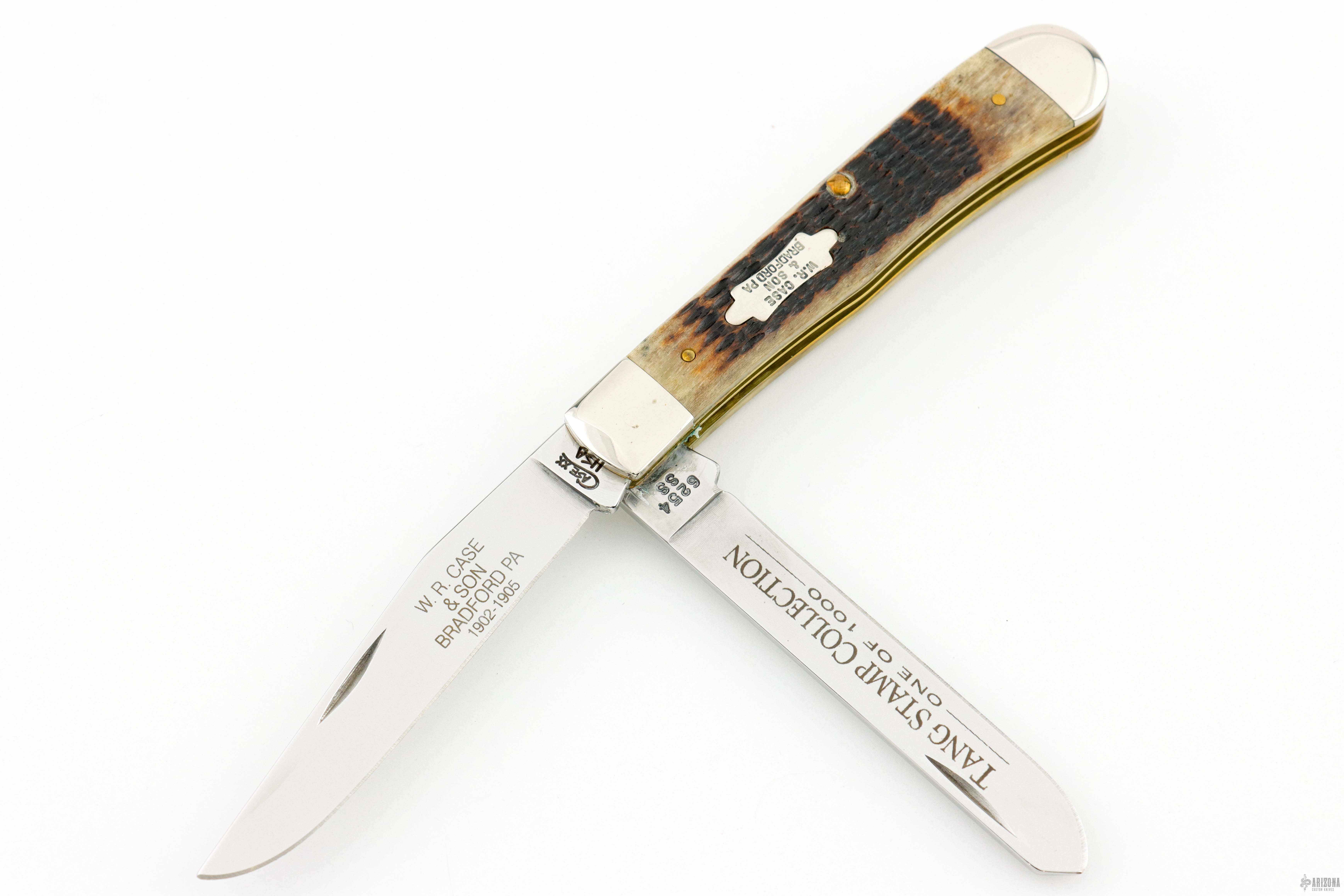
The style of the “S” in “Case” or “USA” reveals the blade steel.
Lightning “S”
- Zigzag or sharp angles
- ✅ Stainless steel
- Used in 1980s, 2020s, and select modern models
Soft “S”
- Smooth, rounded curves
- ✅ Carbon steel
- Used in 1970s, 2000s, 2010s
🔍 Example: A 2024 Trapper with lightning S = stainless steel
A 2024 Trapper with soft S = carbon steel
This is a reliable test even if other markings are worn.
Spot Rare and Valuable Models
Eisenhower Knife
- Believed to have been given to President Eisenhower’s cabinet
- Features “Case XX” stamp (1940–1964)
- High historical value
- Rare and sought after
Stogman
- “X’s down” tang stamp
- Produced 1940–1964
- Red bone handle versions are especially collectible
Whittler / Half Whittler
- Popular in the 1970s
- Features a low spot in the handle
- Collectors value original etching and bone quality
Canoe
- Distinctive shape
- Often found with 1974 tang stamp (2, 4, 5, or 6 dots)
- High value due to rarity and original condition
Copperhead (Style DR62109X)
- Stainless steel model
- Style number “109” = Copperhead
- Searchable online for full specs
Use Style Numbers for Exact ID
Some Case knives have style numbers like DR62109X stamped near the tang.
- “109” = Copperhead
- “62” = Trapper variant
- These can be searched online to confirm:
- Model name
- Materials
- Steel type
- Limited edition status
Use sites like Case’s official database, KnifeTalk forums, or Facebook collector groups to verify.
Tang Stamp Series: Collector’s Edition
Case released a special Tang Stamp Series featuring historical stamps engraved on the bolster.
Features:
- Peach Seed Jig Olive Green Bone Handles
- Tru-Sharp™ Surgical Steel blades
- Center bolster with evolution of tang stamps
Stamps Included:
- 1920–1940: Tested XX
- 1940–1964: Case XX
- 1965–1969: Case XX USA
- 1970–1979: Round C
- 1980–1989: Square C
- 1993–1999: Long Tail C
- 2000–2009: X’s & Dots
- 2010–2019: Curve C
- 2020–2029: Square C
Available in 9 classic patterns, including Trapper, Stockman, and Canoe—perfect for collectors.
Avoid Common Dating Mistakes
❌ Misreading the “C” Style
- Round C ≠ Square C — they mark different decades
- Use a loupe or magnifying glass for clarity
❌ Confusing Dot Placement
- Below “U.S.A.” = 1970s
- Above “U.S.A.” = 1980s, 1990s, 2020s
❌ Ignoring the “S”
- Lightning S means stainless, not just style
- Critical for identifying modern carbon vs. stainless builds
❌ Assuming All XX’s Are Dates
- “XX” is a trademark, not a year
Preservation and Value Tips
Keep Original Condition
- Original etching, unmarked blades, and intact handles increase value
- Avoid polishing or deep cleaning
Store Properly
- Use knife rolls or display cases
- Store in dry, temperature-controlled areas
- Lightly oil blades and pivots with mineral oil
Document Provenance
- Knives with history (e.g., Eisenhower model) are worth more
- Keep photos, receipts, or family stories
Clean Safely
- Use soft cloth and mild soap
- Never use bleach or harsh chemicals
- Dry immediately
Quick Reference: How to Date Any Case Knife
For Knives 1970–2029:
- Count the dots or X’s
- Identify the “C” style
- Check the “S” for steel type
- Match to the decade table
For Knives Before 1970:
- Use font and stamp style
- Look for “Tested XX”, “Case XX”, or “Case XX USA”
- Consult collector guides or forums
Final Thoughts
Dating a Case knife is more than a hobby—it’s a way to connect with American craftsmanship and history. With a clear system of tang stamps, dots, and letter styles, Case has made it possible to pinpoint production years with remarkable accuracy.
Whether you’re identifying a 1974 Trapper, a 1987 stainless Whittler, or a 2024 Canoe, the process is straightforward once you know what to look for. Use this guide, keep a tang stamp chart handy, and always photograph the tang clearly for best results.
📌 Pro Tip: Visit casexx.com/Library/TangStamp.asp for the official Case tang stamp chart—the most reliable reference for collectors.