If you’re wondering what size knife is legal in California, the answer isn’t as simple as a single number. Unlike many states that set a clear blade-length limit, California doesn’t ban knives based on size alone. Instead, legality hinges on knife type, how it’s carried, where you are, and local laws. A 6-inch folding knife is perfectly legal when closed in your pocket, while a 2-inch switchblade could land you in jail.
This complexity leads to widespread confusion. Many people ask: “Is a 3-inch knife legal?” or “Can I carry a 4-inch pocketknife?” But in reality, a 3-inch switchblade is illegal, while a 6-inch hunting knife is legal if openly carried in a sheath. Misunderstanding these rules can result in misdemeanor charges—or even felony convictions.
In this guide, you’ll learn exactly what makes a knife legal or illegal under California law. We’ll break down state statutes, court rulings, and local restrictions so you can carry with confidence—without breaking the law.
Folding Knives: Always Legal When Closed
Folding knives—including pocketknives, multi-tools, and tactical folders—are the most legally protected type of knife in California. As long as the blade is closed, you can legally carry any folding knife, regardless of blade length.
No Blade Length Limit for Closed Folders
Under Penal Code § 17235, California law explicitly allows the possession and carry of folding knives in the closed position—no matter how long the blade is. A 5-inch tactical folder, a 4-inch Swiss Army knife, or even a large utility knife is fully legal when folded and stored in your pocket or bag.
This makes folding knives the safest choice for everyday carry (EDC). As long as the blade stays closed, you’re protected by state law.
Locking vs. Non-Locking Folders: The Legal Difference
Not all folding knives are treated the same under the law:
-
Non-locking (slip joint) knives: These traditional pocketknives, like a classic Swiss Army model, cannot be classified as dirks or daggers, even if the blade is open and in your pocket. This was confirmed in People v. Castillolopez (2016), where the California Supreme Court ruled that a non-locking knife is never a concealed weapon.
-
Locking folding knives: If the blade is locked open and carried on your person, it may be considered a concealed dirk or dagger under Penal Code § 21310. While not automatically illegal, carrying a locked folder increases legal risk during police encounters.
Pro Tip: Always carry locking folders closed and in your pocket. Even if legal, an officer might misinterpret a locked blade as a weapon.
Assisted-Opening Knives Are Legal
Knives that open with a flipper, thumb stud, or assisted mechanism (but require manual pressure) are not switchblades under California law. As long as the knife has a detent—a spring or resistance that keeps the blade closed—it’s considered a manual folder.
This distinction was upheld in In re: Gilbert R (2012), confirming that assisted-openers are legal if carried closed. Just remember: never carry one with the blade open and locked in your pocket.
Fixed-Blade Knives: Open Carry Only

Fixed-blade knives—like hunting knives, Bowie knives, or survival blades—are legal to own but strictly regulated when carried.
Open Carry Rule: Sheathed and Suspended from the Waist
Under Penal Code § 20200, a fixed-blade knife is not considered concealed if it’s carried in a sheath openly suspended from the waist. This means:
- The sheath must be belt-mounted.
- The knife must be visible, not hidden under a jacket or shirt.
- It should be worn on the side or back, where it’s clearly seen.
This is the only legal way to carry a fixed blade on your person in public.
Concealed Carry Is a Crime
Carrying a fixed blade in your pocket, waistband, backpack, or glove box on your person is illegal under Penal Code § 21310, which bans concealed dirks or daggers. Even if you’re a hunter or tradesperson, concealed carry can lead to arrest.
Prosecutors don’t need to prove you intended to use the knife as a weapon—only that it could be used to stab or inflict harm (People v. Rubalcava).
Warning: Pocket clip carry (even for large folders) is not legal open carry. It’s considered concealed and may result in charges.
Switchblade Knives: 2-Inch Blade Limit
Switchblades—knives that open automatically by button, spring, or wrist flick—are heavily restricted.
Illegal If Blade Is 2 Inches or Longer
Penal Code § 21510 bans the possession, sale, or transfer of switchblades with blades 2 inches or longer—whether carried openly or concealed.
- ✅ Legal: Switchblade with less than 2-inch blade
- ❌ Illegal: Switchblade with 2-inch or longer blade
Blade length is measured from the tip to where the blade meets the handle, including any unsharpened portion.
Assisted-Openers Are Not Switchblades
Knives that require manual pressure (e.g., flipping a thumb stud) and have a detent are not switchblades. As long as it doesn’t open fully with a single button press, it’s legal if carried closed.
Visual Cue: If it doesn’t open automatically, it’s not a switchblade.
Some Cities Ban All Switchblades
Local laws can be stricter:
- San Francisco: Bans switchblades of any length
- Los Angeles County: Enforces the 2-inch limit, but local enforcement varies
Always check city codes before carrying.
Banned Knives: Never Legal in California
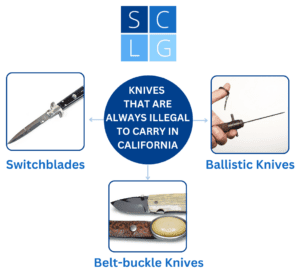
Certain knives are illegal to own, carry, sell, or make—no exceptions.
| Knife Type | Why It’s Banned |
|---|---|
| Ballistic Knife | Ejects blade via spring or explosion |
| Cane Sword | Concealed blade in a walking cane |
| Belt Buckle Knife | Hidden blade in a belt buckle |
| Lipstick Knife | Disguised as cosmetics |
| Pen Knife | Hidden in a writing pen |
| Undetectable Knife | Made of non-metallic materials |
| Gravity Knife / Butterfly Knife (Balisong) | Opens via gravity or wrist flick |
These fall under Penal Code § 16590 as “generally prohibited weapons.” Possession is a “wobbler” offense—can be charged as misdemeanor or felony.
Penalty: Up to 3 years in prison and/or $10,000 fine.
Note: Butterfly knives are illegal because they qualify as gravity knives, which open by centrifugal force.
School Zones: 2.5-Inch Rule
Even if a knife is legal elsewhere, schools and colleges have strict rules under Penal Code § 626.10.
Illegal Knives on School Grounds
You cannot carry on K–12 or college campuses if you have:
- Any knife with a blade longer than 2.5 inches
- Locking-blade folding knives (any length)
- Box cutters, razor blades, or ice picks
- Dirks, daggers, or switchblades
Exceptions
- Non-locking folding knives with blade 2.5 inches or shorter
- Knives used for school activities (e.g., culinary class, woodshop)
- Lawful occupational use (e.g., maintenance worker with utility knife)
Penalty: Misdemeanor (up to 1 year jail) or felony (up to 3 years).
Public Buildings: 4-Inch Blade Limit
Penal Code § 171b bans certain knives in government buildings, including:
- Courthouses
- City halls
- Public meetings
- Airports and transit terminals
Banned Knives
- Any knife with a blade longer than 4 inches that is fixed or can be locked open
- Box cutters (explicitly banned in airports)
- Undetectable knives (in sterile transit areas)
Penalty: “Wobbler” offense—misdemeanor or felony, up to 3 years.
Local Laws Can Be Stricter
California has no statewide preemption, so cities can ban knives more strictly than the state.
| City/County | Knife Law |
|---|---|
| Los Angeles | Bans open carry of knives with blade ≥ 3 inches |
| San Francisco | Bans all switchblades; knives ≥ 3 inches are “dangerous weapons” |
| Oakland | Prohibits carrying knives with blades ≥ 3 inches |
| Sacramento County | Bans knives on county property |
| San Diego County | Bans throwing knives in county parks |
Example: A 3.5-inch folder is legal statewide if closed—but illegal in LA or Oakland.
Action Step: Always check municipal codes before traveling.
Carrying Knives in Your Car
You can legally store a knife in your vehicle, even if it’s within reach.
Legal Storage Options
- Glove box
- Center console
- Trunk
- Under seat (in sheath)
Key Rule: As long as the knife is not on your person, it’s not considered concealed under state law.
Veteran law enforcement expert Tgryphon confirms: “A fixed blade knife, regardless of size, can be concealed anywhere but upon your person.”
Best Practices
- Keep in a secured sheath
- Avoid immediate driver access (e.g., under seat)
- Don’t store prohibited knives (e.g., switchblades >2″)
Warning: Officers may investigate based on behavior, location, or criminal history—even if you’re technically legal.
Final Tips for Legal Compliance
- Folding knives are safest—carry them closed.
- Fixed blades must be openly carried in a waist-suspended sheath.
- Avoid switchblades with 2-inch or longer blades.
- Check local laws—LA, SF, and Oakland have stricter rules.
- Never carry on school grounds unless exempt.
- Store vehicle knives securely—glove box or trunk is best.
- Use knives as tools, not weapons—intent influences legal outcomes.
- When in doubt, consult a lawyer—especially for unusual knife types.
Bottom Line: What Size Knife Is Legal?
There is no single legal blade length in California. Instead, legality depends on:
- Type: Folding, fixed, or automatic?
- Carry method: Open or concealed?
- Location: State, local, school, or federal property?
- Local rules: City bans may override state law?
Universal Rule:
✅ Folding knives are legal if carried closed—no matter the size.
❌ Fixed blades must be openly carried; concealed carry is a crime.
❌ Switchblades ≥2 inches are banned statewide.
Stay safe, stay legal: Know your knife, know the law, and always check local rules before you carry.