If you’ve ever struggled to slice a ripe tomato, only to have it cling stubbornly to your blade, or watched delicate pieces of salmon stick and tear instead of releasing cleanly, you know how frustrating food adhesion can be. The solution? A hollow edge knife—a smart blade design engineered to reduce drag and keep slices smooth, fast, and stick-free.
Also known as a Granton edge knife, this type of blade features shallow, oval-shaped indentations—called hollows or flutes—along the flat sides of the blade. These aren’t decorative; they’re functional. By creating tiny air pockets between the knife and the food, they break surface tension and prevent ingredients from sticking. Originally patented in 1928 by the Grant & Edge Company, this innovation was first used in professional butchery, where clean, efficient slicing was essential.
Today, hollow edges are commonly found on santoku knives, slicing knives, and other precision blades. But while they promise effortless cutting, their real-world performance is debated. Are they a game-changer—or just a cosmetic trend? In this guide, you’ll learn how hollow edge knives work, where they excel, how they compare to other blade types, and whether they’re worth adding to your kitchen.
How Hollow Edge Knives Reduce Food Sticking
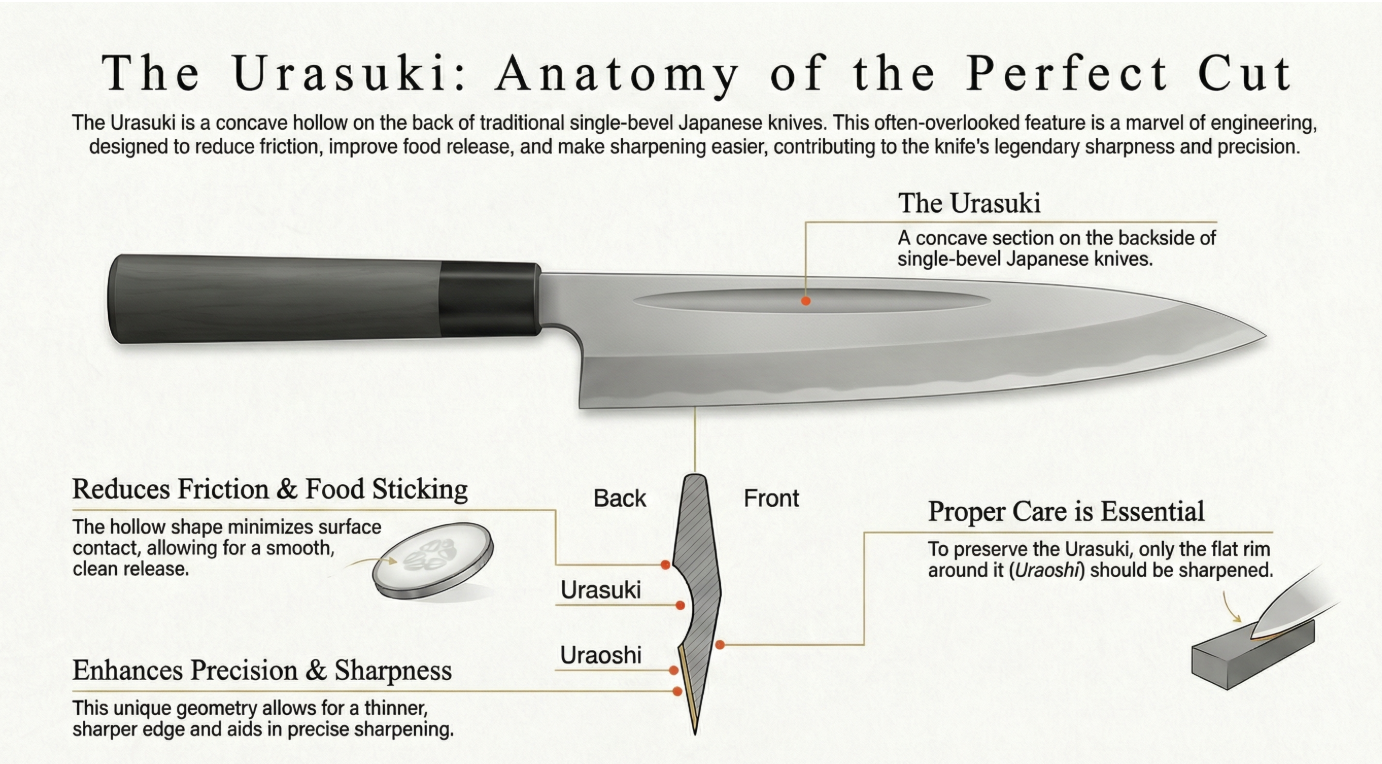
Air Pockets Minimize Surface Contact
The science behind hollow edge knives is simple but effective: less contact equals less sticking. The dimpled grooves ground into the blade’s sides create small air pockets that act like cushions between the metal and the food. When you slice through moist or soft ingredients, these pockets disrupt suction and reduce friction, allowing each piece to drop away cleanly.
Think of it like a non-stick pan—by minimizing direct surface contact, food slides off instead of clinging. This is especially useful for foods high in moisture or slight tackiness, such as raw fish, tomatoes, or cured meats.
Hollows Are Not on the Cutting Edge
A key detail: the hollows do not affect the sharp edge of the knife. They’re carved into the flat sides of the blade, running vertically from the spine down toward the edge—but stopping short. This preserves the blade’s sharpness and structural integrity while still delivering the anti-stick benefit. The actual cutting edge remains smooth and continuous, just like a plain blade.
Key Benefits of a Hollow Edge Design
Cleaner, Faster Slicing with Less Effort
Because the blade glides through food with reduced resistance, hollow edge knives deliver:
– Thinner, more consistent slices
– Faster prep times during repetitive cutting tasks
– Reduced hand fatigue, especially during long sessions
This makes them ideal for slicing roasts, carving smoked fish, or portioning deli meats—tasks where speed and precision matter.
Lighter, Thinner Blade for Better Control
Removing material from the blade face does more than create air pockets—it also makes the knife lighter and thinner. This improves balance and allows for smoother, more controlled slicing motions. For chefs who value agility and finesse, especially in Japanese-style prep, this can be a major advantage.
Structural Strength Is Preserved
Despite the missing metal, the spine and cutting edge remain intact. High-quality hollow edge knives are engineered so that strength is concentrated where it matters most—along the spine and edge—while still benefiting from reduced friction on the flats.
Best Uses for Hollow Edge Knives
Ideal for Moist, Sticky, or Delicate Foods
Hollow edges perform best when slicing ingredients that tend to stick to flat blades. Common examples include:
– Raw fish (salmon, tuna, sashimi)
– Cured meats (prosciutto, ham, salami)
– Juicy vegetables (tomatoes, cucumbers, zucchini)
– Boneless poultry or pork
These foods often cling due to moisture and surface tension—exactly the problem hollow edges are designed to solve.
Designed for Slicing, Not Chopping
Hollow edge knives shine during long, smooth slicing motions. They’re most effective on:
– Slicing knives (for roasts, hams, smoked fish)
– Santoku knives (especially for fish and vegetable prep)
– Carving and cimeter knives
They’re less beneficial on short blades used primarily for dicing, mincing, or heavy chopping, where the hollows offer little advantage.
Hollow Edge vs. Plain Edge vs. Serrated Edge
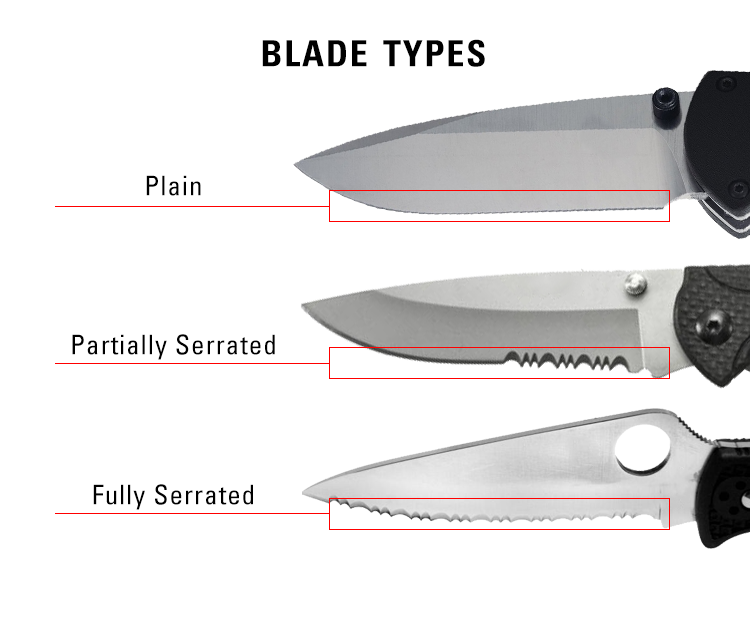
| Feature | Hollow Edge | Plain Edge | Serrated Edge |
|---|---|---|---|
| Blade Surface | Scalloped with air pockets | Smooth, solid surface | Toothed, saw-like edge |
| Best For | Thin slicing; sticky foods | Chopping, peeling, precision cuts | Crusty bread, tough skins |
| Food Release | Excellent (with deep hollows) | Moderate (may stick) | Good on crusts, poor on soft interiors |
| Cut Quality | Clean, paper-thin slices | Precise, controlled cuts | Effective on hard exteriors |
| Maintenance | Requires careful sharpening | Easy to hone and sharpen | Difficult to resharpen properly |
| Common Examples | Santoku (hollow edge), slicing knives | Chef’s knife, paring knife | Bread knife, tomato knife |
Pro Tip: A well-polished plain edge knife can outperform a poorly executed hollow edge. It’s not the dimples—it’s the grind and sharpness that truly matter.
Hollow Edge Santoku Knives: Why So Popular?
The Go-To Choice for Japanese-Style Prep
The santoku knife is the most common home for hollow edges. Designed for slicing, dicing, and mincing, it’s a staple in modern kitchens—especially those influenced by Japanese cuisine. The addition of hollows enhances its performance when preparing fish and vegetables, where clean, thin cuts are essential.
Many cooks assume all santokus have hollow edges, but they’re actually an optional feature. Some high-end models, like the Misono UX10, achieve excellent food release without any hollows—relying instead on ultra-thin geometry and a mirror-polished finish.
Features of High-Performance Hollow Edge Santokus
- Blade Length: Typically 5″ to 7″
- Edge Angle: 15°–20° (some go below 15° for ultra-fine slicing)
- Steel Types:
– VG-10: Japanese stainless steel with excellent edge retention
– Damascus: Layered steel for durability and visual appeal (e.g., 67-layer Kyoku Shogun)
– 440C: Rust-resistant, affordable, moderately hard
– High-carbon steel: Sharp but requires rust prevention - Handle Materials: Rosewood, fiberglass, or composite for grip and balance
- Full Tang Construction: Ensures durability and stability
Popular Hollow Edge Santoku Models
- Kyoku Shogun 7″ Santoku (Damascus): 67-layer blade with herringbone pattern and deep hollows
- Kyoku Daimyo 7″ Santoku (440C): 13–15° razor edge, rosewood handle, mosaic pin
- Kyoku Gin 7″ Santoku (VG10 Damascus): Cryo-treated core, ionic silver coating, fiberglass handle
Do Hollow Edges Really Work? The Truth Behind the Hype
Experts Are Divided
There’s no universal agreement on whether hollow edges make a meaningful difference. Here’s what users and professionals say:
✅ Supporters Say:
- Hollows improve food release, especially on longer blades
- Air pockets reduce drag during continuous slicing
- Valuable in high-volume kitchens where speed counts
❌ Skeptics Argue:
- No noticeable difference between hollow and plain edge models (e.g., Zwilling Pro santoku)
- Blade grind and polish are more important than dimples
- Hollows can wear down, creating micro-serrations or “knifegore”
- Repeated sharpening reduces blade height, eventually eliminating the hollows
“Do they ‘work’? No. Do I notice a difference? Yes. It’s generally a bad thing.” – Commenter “thepuncroc”
This suggests that while hollow edges may offer marginal benefits, they can also introduce long-term maintenance issues.
Design Quality Determines Real-World Performance

Not all hollow edges are created equal. Effectiveness depends on:
– Depth: Shallow dimples do little; deeper hollows create real air gaps
– Spacing: Wider spacing improves airflow and release
– Alignment: Must run parallel to the edge for consistent performance
Knives like the Glestain or Takayuki Grand Chef SP series feature large, pronounced scallops designed for maximum effect.
By contrast, some premium knives—like the Misono UX10 santoku—deliver superior food release without any hollows, relying instead on:
– Ultra-thin blade geometry
– Mirror-polished flats
– Precise convex or flat grinds
This proves that hollows are helpful, but not essential, for achieving clean cuts.
How to Maintain a Hollow Edge Knife
Clean by Hand Only
- Never put in the dishwasher. Harsh detergents and heat can damage the blade and handle.
- Wash immediately after use with warm, soapy water.
- Dry thoroughly to prevent rust, especially on high-carbon or Damascus steels.
Store Properly
- Use a knife block, magnetic strip, or sheath.
- Avoid loose storage where blades can bump against other utensils.
Sharpen with Care
- Use a ceramic rod or fine diamond stone for honing.
- Avoid aggressive sharpening methods that remove too much metal.
- Focus on maintaining the edge angle without grinding into the hollows.
Warning: Over time, repeated sharpening will shorten the blade and may flatten the hollows, potentially turning them into unintended micro-serrations.
Are Hollow Edge Knives Worth It?
✅ When to Choose One
- You frequently slice moist or sticky foods
- You use long-bladed knives for carving or sashimi
- You want faster, cleaner cuts with less effort
- You appreciate the modern look of scalloped blades
❌ When to Skip It
- You mostly chop or dice (hollows add no benefit)
- You own a high-performance plain edge knife
- You sharpen frequently and want long-term blade longevity
- You prioritize simplicity and ease of maintenance
Bottom Line: Hollow edges can help—but only under the right conditions. They’re not a substitute for quality steel, sharpness, or proper grind.
Buyer’s Guide: Choosing the Right Hollow Edge Knife
1. Prioritize Blade Quality First
Don’t choose a knife just because it has hollows. Focus on:
– Steel type (VG-10, Damascus, high-carbon)
– Edge retention
– Sharpness out of the box
– Grind quality and polish
2. Look for Deep, Well-Spaced Hollows
Shallow or tiny dimples may look cool but do little. Opt for:
– Deep scallops
– Even spacing
– Full-length coverage from tip to heel
3. Check Handle Comfort and Balance
A great blade means nothing if the handle fatigues your hand. Look for:
– Ergonomic shape
– Non-slip material (rosewood, composite)
– Full tang construction
4. Know That Hollows Won’t Last Forever
With regular sharpening, the blade shortens. Eventually:
– Hollows may disappear
– Blade height decreases
– Performance shifts toward a plain edge
Plan for long-term use—not just initial appeal.
Final Thoughts: Function vs. Fashion
Hollow edge knives solve a real problem—food sticking to blades—but their effectiveness varies widely. On long slicing knives, they deliver clear benefits. On short santokus, the advantage is often negligible, especially when compared to a well-crafted plain edge.
Top-tier knives like the Misono UX10 prove that superior geometry and polish matter far more than dimples. For most home cooks, a high-quality chef’s knife or plain edge santoku will perform just as well—if not better—than a hollow edge model.
So, are hollow edges worth it?
Sometimes. But never at the expense of blade quality.
Choose based on overall performance, not just the presence of scallops. And remember: the best knife is the one that cuts cleanly, feels balanced in your hand, and stands the test of time—whether it’s dimpled or not.