If you’re searching for a reliable, affordable folding knife under $40, chances are you’ve encountered 8Cr13MoV steel. Found in popular models from Kershaw, Spyderco, CRKT, and SOG, this Chinese stainless steel has become a staple in budget-friendly EDC (everyday carry) knives. Yet it’s often dismissed online with labels like “junk steel” or “outdated”—but is that really fair?
Yes, 8Cr13MoV is good knife steel—when properly heat-treated and priced fairly. While it won’t match high-end alloys like S30V or MagnaCut in edge retention, it delivers impressive toughness, solid corrosion resistance, and effortless sharpening. For daily tasks, beginners, and hard-use environments, it’s a smart, practical choice that punches above its price point.
The real issue isn’t the steel itself—it’s inconsistent manufacturing and inflated pricing that tarnish its reputation. A $30 knife with 8Cr13MoV can be an outstanding value. A $90 knife with the same steel? That’s where the criticism starts to make sense.
In this guide, you’ll learn exactly how 8Cr13MoV performs, how it stacks up against other steels, which brands use it best, and when it’s worth buying—or avoiding.
What Is 8Cr13MoV Steel?
8Cr13MoV is a Chinese stainless steel designed for mass production of affordable knives. It’s widely regarded as the functional equivalent of Japanese AUS-8, with nearly identical chemical composition and real-world performance. Despite its budget status, it offers a balanced mix of hardness, edge retention, toughness, and rust resistance.
The name breaks down key elements:
– “8” = ~0.8% carbon (boosts hardness and wear resistance)
– “Cr13” = 13–14.5% chromium (provides stainless properties)
– “Mo” = molybdenum (enhances strength and corrosion resistance)
– “V” = vanadium (improves grain refinement and wear resistance)
Produced via conventional casting, not powder metallurgy, 8Cr13MoV can have minor inconsistencies like carbide stringers—but these don’t significantly impact performance for everyday use. It’s not a premium steel, but it’s far from useless.
Chemical Composition and Performance

Key Elements in 8Cr13MoV
| Element | Content | Role in Performance |
|---|---|---|
| Carbon (C) | 0.7–0.8% | Increases hardness and edge retention |
| Chromium (Cr) | 13–14.5% | Provides rust resistance and stainless properties |
| Molybdenum (Mo) | 0.1–0.3% | Enhances strength, hardenability, and corrosion resistance |
| Vanadium (V) | 0.1–0.25% | Improves wear resistance and refines grain structure |
| Manganese (Mn) | ~1% | Aids in hardening and deoxidizing |
| Silicon (Si) | Trace | Strengthens steel during melting |
This blend places 8Cr13MoV between 440A and 440C in performance—softer than 440C but tougher and easier to sharpen.
How It Compares Chemically
- Nearly identical to AUS-8—differences are negligible in practice
- Higher carbon than 420HC, making it harder and more durable
- Less chromium than 14C28N or 9Cr18MoV, so slightly less corrosion-resistant
- Contains vanadium, unlike 440 series, giving better wear resistance
Its chemistry supports real-world usability, especially in humid or abusive conditions, making it a dependable choice for EDC and utility use.
Hardness and Heat Treatment: Why It Matters
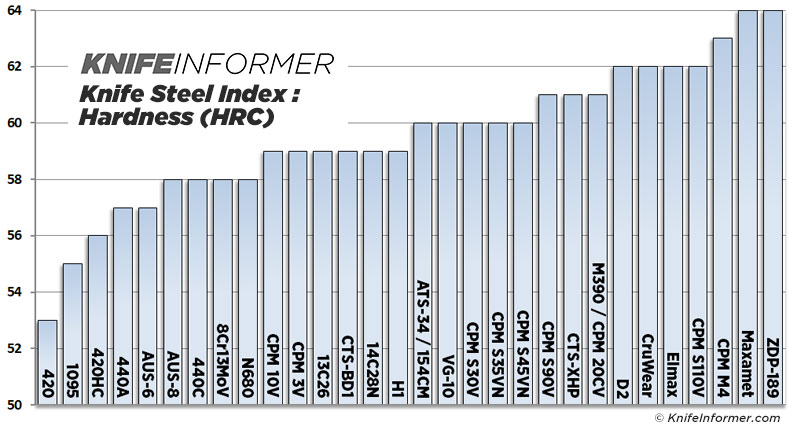
Typical Hardness Range
8Cr13MoV usually achieves 57–60 HRC in factory knives, with potential up to 64.5 HRC under optimal heat treatment.
- Standard range: 58–60 HRC
- Best balance (toughness + edge): 59–61 HRC
- Maximum (with cryo): 64.5 HRC
Higher hardness isn’t always better—grain growth occurs at 1050°C, so overheating can degrade performance.
Optimal Heat Treatment
- Austenitizing: 1025–1050°C (1875–1925°F)
- Tempering: 300–350°F (150–180°C)
- Cryogenic treatment: Optional, increases hardness and stability
Austenitizing at 1025°C is safer for fine grains; 1050°C risks coarsening.
Why Heat Treatment Is Critical
Performance varies dramatically based on how the steel is heat-treated. Brands like Spyderco and Kershaw apply reliable processes, while cheaper knockoffs may underperform due to poor heat treatment.
Bottom line: A well-heat-treated 8Cr13MoV knife can outperform many pricier models with inferior processing.
Microstructure and Consistency
Carbide Structure
- Fine to moderate carbides, smaller than in 440C or VG-10
- Carbide stringers and segregation present due to conventional casting
- Stringers can cause minor grinding defects but don’t affect function
While not as uniform as powder steels (e.g., S30V, M390), its microstructure is typical for non-PM steels and performs reliably.
Comparison to Other Steels
| Steel | Carbide Size | Uniformity | Notes |
|---|---|---|---|
| 8Cr13MoV | Fine | Moderate | Good balance |
| 440C | Coarse | Low | More brittle |
| S30V | Very fine | High | Powder steel advantage |
| 14C28N | Fine | High | Superior alternative |
It’s not the most refined steel, but it’s consistent enough for EDC and field use.
Mechanical Properties: Toughness, Edge Retention, and More

Toughness: Surprisingly Strong
- Toughness rating: 6/10
- Outperforms: D2 (3.5), 440C, M390, XHP
- Matches: S30V, 14C28N, A2
This means resistance to chipping, rolling, and impact is excellent—even under prying or heavy cutting.
Real-world benefit: Fewer edge failures during abuse.
Edge Retention: Moderate
- Rating: 3/10 (moderate)
- CATRA test results:
- 61 HRC: 395 mm cardstock cut
- 62.5 HRC: 376 mm (slightly worse due to stringers)
Softer treatments sometimes outperform harder ones—likely due to carbide alignment at the edge.
Still better than AEB-L, on par with 14C28N at same hardness, but below VG-10, 154CM, or S30V.
Corrosion Resistance: Good for Class
- Rating: 7/10
- Resists rust in humid or wet environments
- Requires basic care: clean, dry, occasional oil
Not as good as 18% Cr steels (like 14C28N), but better than D2 or carbon steels.
Sharpening Ease: One of the Best
- Extremely easy to sharpen
- Works with:
- Whetstones
- Pull-through sharpeners
- Electric sharpeners
- Pocket rods
Even beginners can restore a razor edge in minutes. This is a major plus for frequent users.
Real-World Performance: How It Holds Up
Everyday Carry (EDC) Use
- Tasks: Box cutting, package opening, light food prep, rope slicing
- Edge life: Touch-up needed midweek with heavy use
- Failure mode: Edge rolls, not chips—easier to fix
- User reports: No breakage, reliable performance
Ideal for users who use their knife daily and don’t mind quick touch-ups.
Field and Bushcraft Use
- Cuts green wood, cordage, and rope effectively
- No chipping recorded in field tests
- Rolled edges common under stress, but easily corrected
- Lightweight models (e.g., CRKT S.P.I.T.) pack well
Not a survival primary, but a solid backup or utility blade.
How It Compares to Premium Steels
| Steel | Edge Retention | Toughness | Corrosion | Sharpening | Best For |
|---|---|---|---|---|---|
| 8Cr13MoV | 3/10 | 6/10 | 7/10 | Very Easy | EDC, light tasks |
| S30V | 8/10 | 6.5/10 | 7/10 | Moderate | High-end EDC |
| D2 | 5/10 | 3.5/10 | 5/10 | Difficult | Heavy cutting |
| M390 | 9/10 | <6/10 | 8/10 | Difficult | Premium folders |
| 14C28N | 4/10 | 6.5/10 | 8/10 | Easy | Outdoor use |
8Cr13MoV wins in toughness and sharpening ease, loses in edge life—but holds its own in real use.
Top Brands and Best 8Cr13MoV Knives to Buy
Who Uses 8Cr13MoV?
| Brand | Example Knives |
|---|---|
| Kershaw | Natrix XL, Atmos, Cryo |
| Spyderco | Persistence, Resilience, byrd line |
| CRKT | S.P.I.T., Minimalist |
| Cold Steel | Various folders and fixed blades |
| SOG | Flash, Terminus lines |
| Honey Badger Knives | Compact EDC models |
These companies use 8Cr13MoV in entry-level to mid-tier models, keeping prices low while offering solid performance.
Best Value 8Cr13MoV Knives
| Model | Brand | Why It’s Great |
|---|---|---|
| Kershaw Natrix XL | Kershaw | Flipper, G-10, sub-frame lock, great action |
| Spyderco Persistence | Spyderco | Compact, tough, excellent heat treat |
| CRKT S.P.I.T. | CRKT | Tiny fixed blade, full tang, ultra-light |
| Kershaw Atmos | Kershaw | Smooth action, lightweight, popular |
| Spyderco Resilience | Spyderco | Known for top-tier performance in this steel |
These models prove that with good design and heat treatment, 8Cr13MoV shines.
Final Verdict: Should You Buy a Knife with 8Cr13MoV?
Strengths of 8Cr13MoV
✅ Excellent toughness—resists chipping and breaking
✅ Good rust resistance—safe for humid or wet use
✅ Very easy to sharpen—perfect for beginners
✅ Balanced performance—reliable for daily tasks
✅ Affordable—enables quality design under $50
Weaknesses
❌ Moderate edge retention—needs more frequent touch-ups
❌ Heat treatment varies—brand matters
❌ Overpriced models exist—avoid $60+ 8Cr knives
❌ Stigma—unfairly labeled “junk” by some
When to Choose It
✔️ EDC under $40
✔️ Knives for heavy daily use
✔️ Beginners learning sharpening
✔️ Knives for high-loss environments (job site, travel)
When to Avoid It
✖️ Knives priced over $60
✖️ If you hate sharpening
✖️ Marine or extreme corrosion environments
Conclusion: Is 8Cr13MoV Good?
Yes—when used right.
8Cr13MoV is not a premium steel, but it’s far from junk. It offers real-world durability, rust resistance, and easy maintenance at a fraction of the cost of high-end alloys. For most users, it’s more than enough steel.
The key is context:
– Under $40? Excellent value.
– Over $60? Hard to justify.
– Well-made? Performs like a champ.
– Poorly heat-treated? Frustrating and dull.
Don’t let steel snobbery blind you—8Cr13MoV gets the job done. If you need a reliable, affordable knife for daily life, there’s no shame in choosing 8Cr13MoV.