If you’re shopping for a kitchen knife, pocket blade, or utility tool, chances are you’ve come across 440 stainless steel—a common material in mid- to entry-level cutlery. But is it actually good? The short answer: yes, especially when it’s 440C and properly heat-treated. While some knife enthusiasts dismiss 440 steel as outdated or budget-grade, the reality is that it offers a smart balance of corrosion resistance, edge retention, and affordability—making it a solid choice for everyday users.
440 stainless steel isn’t going to win edge retention contests against high-end alloys like S30V or M390, but it delivers reliable performance for home cooks, EDC (everyday carry) users, and outdoor enthusiasts who want a dependable blade without breaking the bank. The key lies in understanding the differences between its variants—440A, 440B, and 440C—and knowing which one you’re getting.
This guide dives deep into the real-world performance of 440 steel, how it stacks up against other popular knife steels, and who should consider using it. Whether you’re replacing a kitchen knife or choosing your first pocket blade, you’ll walk away knowing exactly where 440 steel shines—and when to look elsewhere.
440A vs 440B vs 440C: Which One Are You Getting?
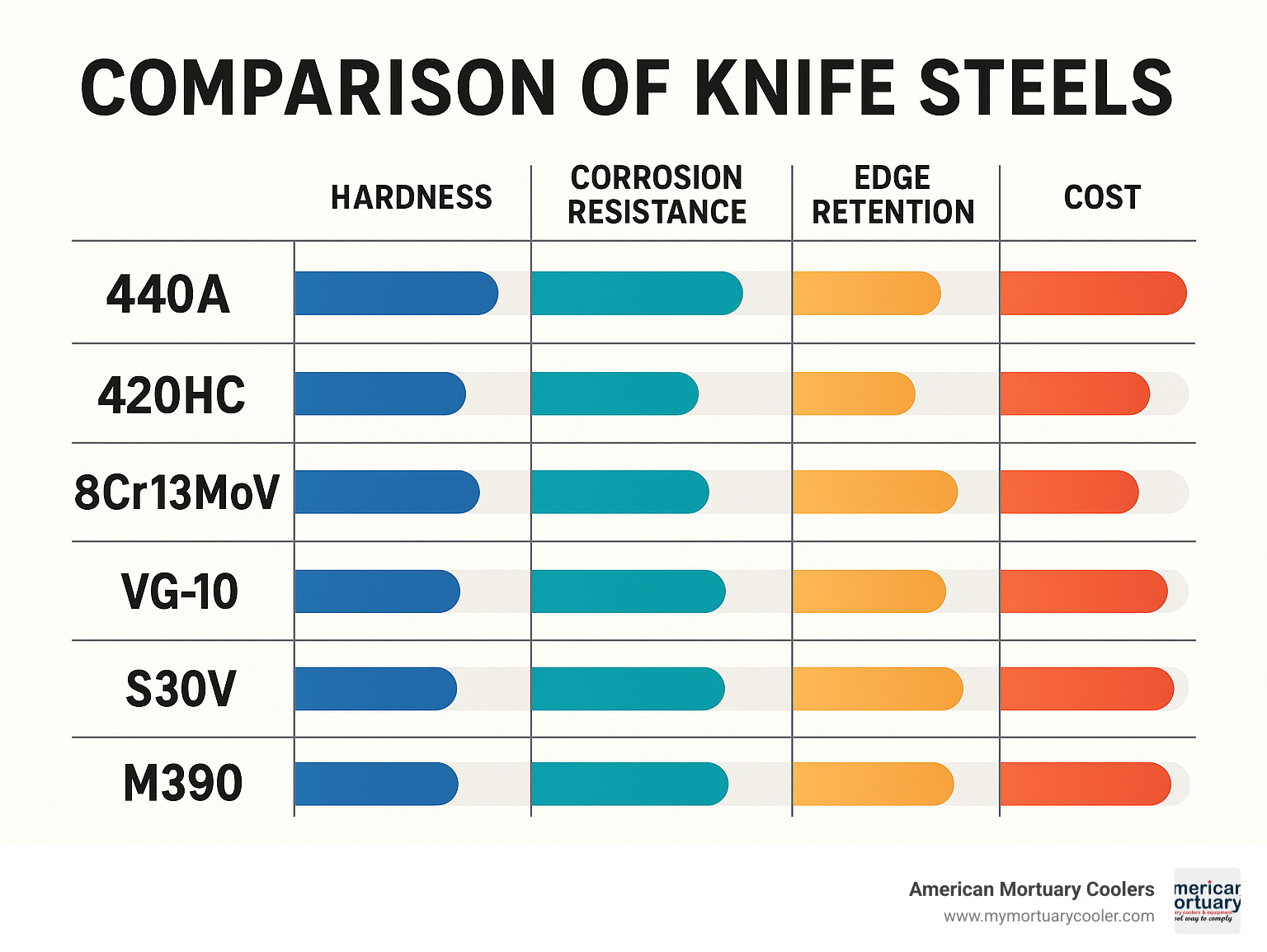
The term “440 stainless steel” covers three distinct alloys, each with increasing carbon content—and performance.
440A: The Budget-Friendly Option
- Carbon: 0.60–0.75%
- Hardness: 54–56 HRC
- Best for: Low-cost, light-duty knives
440A is the most corrosion-resistant of the three thanks to its lower carbon content, but that comes at the cost of edge retention. It’s softer and easier to sharpen, but it dulls quickly under regular use. You’ll often find it in decorative knives or ultra-cheap utility tools—perfect for occasional use, not heavy-duty cutting.
440B: The Forgotten Middle Ground
- Carbon: 0.75–0.90%
- Hardness: 56–58 HRC
Slightly harder than 440A, 440B offers better wear resistance but still doesn’t match 440C. It’s rarely used today, often overshadowed by its more capable sibling. Unless you’re restoring vintage gear, you’re unlikely to encounter it.
440C: The High-Performance Variant
- Carbon: 0.95–1.20%
- Hardness: 58–60 HRC
- Edge retention: Good to very good
- Corrosion resistance: Very good
This is the only variant worth considering for serious cutting. With proper heat treatment, 440C achieves near-premium performance at a fraction of the cost. It holds a sharp edge through slicing meat, vegetables, rope, and cardboard, resists rust from acidic foods and moisture, and maintains reliability over years of use.
✅ Key takeaway: When someone asks, “Is 440 steel good for a knife?” they really mean 440C—the only version that delivers durable, real-world performance.
How 440C Performs in Daily Use
Edge Retention: Sharpness That Lasts
440C keeps its edge significantly longer than softer steels like 420 or 440A. In slicing tests, it outperforms common budget steels and holds its own in kitchen and EDC tasks. While it doesn’t match super-steels like ZDP-189 or CPM-20CV, the difference is often negligible for average users.
For daily chopping, slicing, or opening packages, 440C’s edge retention is more than adequate. You won’t need to sharpen it weekly unless you’re doing heavy-duty work.
Corrosion Resistance: Built for Wet Environments
With 16–18% chromium, 440C resists rust and staining better than most high-carbon steels. It handles:
– Acidic foods (tomatoes, citrus, vinegar)
– Frequent washing
– Humid climates
– Occasional saltwater exposure (if rinsed and dried)
Many users report using 440C knives for years—including fishing, camping, and food prep—without pitting or corrosion. Just avoid leaving it wet or submerged in saltwater for long periods.
Sharpening: Moderate Effort, Long-Term Payoff
Because it’s harder, 440C takes more effort to sharpen than softer steels—but it’s far from impossible. Use:
– Diamond stones: Fast and effective
– Silicon carbide (India) stones: Aggressive cutting
– High-quality water stones: Smooth refinement
– Chromium oxide paste: Great for final polishing (especially on straight razors)
Avoid worn natural stones—they can glaze and slow progress. Expect to spend more time than with 420 steel, but the payoff is a long-lasting, razor-sharp edge.
Toughness: Slicing Over Chopping
440C is a slicing steel, not a chopper. While tough for its class, it can chip or crack under:
– Prying
– Batoning (splitting wood with the spine)
– Lateral stress (twisting motions)
Don’t use it as a hammer, screwdriver, or survival axe. Stick to precision cuts and general utility tasks.
Heat Treatment: The Make-or-Break Factor
Even the best steel fails without proper heat treatment. 440C must be:
1. Austenitized at 880–910°C (1616–1670°F)
2. Quenched in oil or water to form martensite
3. Tempered at 150–370°C (302–700°F) to reduce brittleness
When done right, the blade reaches 58–60 HRC, balancing hardness and resilience. Poorly treated blades may be:
– Too soft: Dulls quickly
– Too brittle: Chips easily
Reputable brands like Kyoku, Benchmade, and Carter Cutlery apply precise heat treatment. Cheap no-name knives may skip quality control—so brand reputation matters.
Where 440C Excels: Real-World Applications
Kitchen Knives: Low-Maintenance & Reliable
440C is ideal for:
– Santoku knives: All-purpose slicing and dicing
– Nakiri knives: Vegetable prep with full-edge contact
– Paring knives: Precision peeling and trimming
Benefits:
– Resists food acids and dishwasher moisture
– Easy to clean and store
– Maintains edge through daily use
– Magnetic—works with knife strips
Kyoku’s Daimyo Series uses 440C in thoughtfully designed kitchen knives focused on real-world usability.
Everyday Carry (EDC) Knives: Affordable & Dependable
Popular in:
– Pocket knives
– Neck knives (e.g., Carter pattern)
– Replacement blades (e.g., Benchmade 940)
Why users love it:
– Won’t rust in a pocket or bag
– Handles box-cutting, tape, and light chores
– Low maintenance—no oiling needed
– Cost-effective
Perfect for beginners or those who want a no-fuss blade that works when needed.
Straight Razors: Razor-Sharp & Polished
440C is a favorite for high-end straight razors because:
– Takes an extremely fine edge
– Holds sharpness through multiple shaves
– Responds well to stropping and polishing
– Chromium oxide paste brings it to a mirror finish
Many barbers and wet shavers use 440C razors daily with excellent results.
Utility & Outdoor Tools
Used in:
– Gardening shears
– Fishing fillet knives (rinse after saltwater!)
– Light camping knives
Thrives in humid or wet conditions thanks to corrosion resistance. Just dry after use.
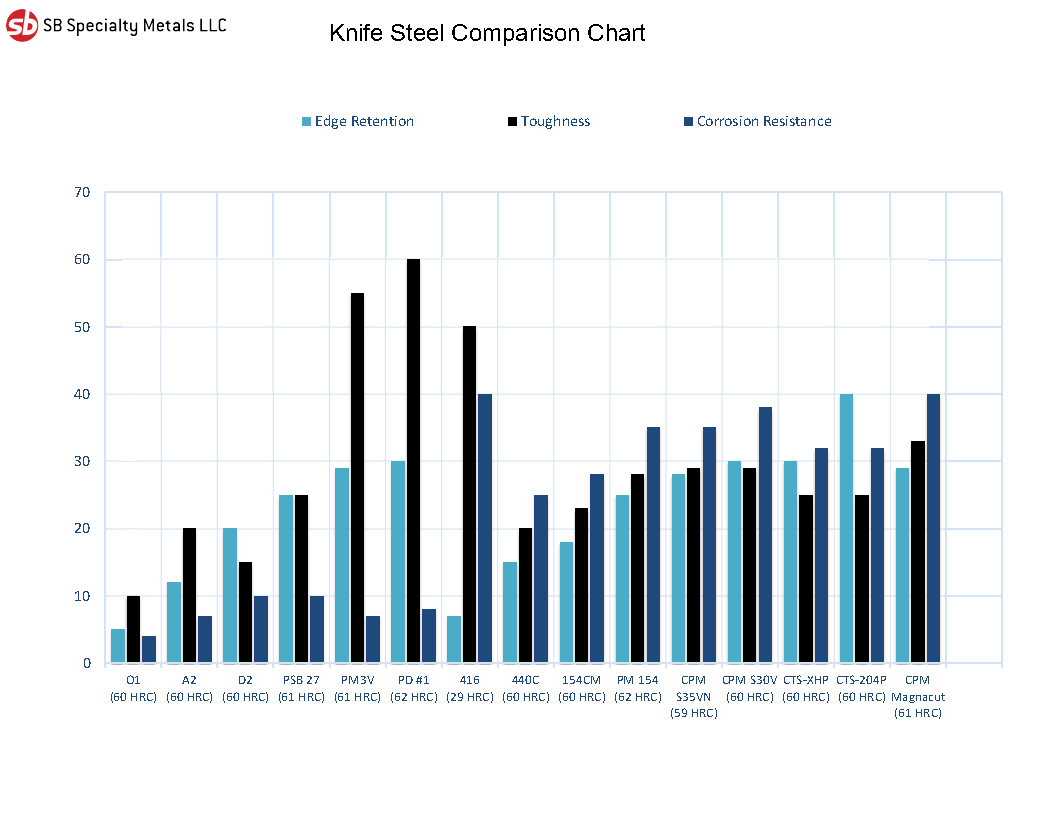
440C vs Other Common Knife Steels
440C vs 420 Stainless Steel
| Feature | 440C | 420 |
|---|---|---|
| Carbon | Up to 1.20% | 0.15–0.40% |
| Hardness | 58–60 HRC | 48–54 HRC |
| Edge Retention | Good | Poor |
| Corrosion Resistance | Very good | Excellent |
| Sharpening | Moderate effort | Very easy |
| Best For | Daily use | Decorative or light-duty |
👉 440C is clearly superior—420 is too soft for serious cutting.
440C vs S30V, 154CM, and D2
| Steel | Edge Retention | Corrosion Resistance | Toughness | Cost |
|---|---|---|---|---|
| 440C | Good | Very Good | Moderate | Low |
| 154CM | Very Good | Good | High | Medium |
| S30V | Excellent | Good | High | High |
| D2 | Excellent | Fair (semi-stainless) | High | Medium |
👉 440C delivers ~80% of the performance of premium steels at ~30% of the cost. Great value.
Advantages of 440 Stainless Steel
✅ High Corrosion Resistance
Resists rust and staining in kitchens, coastal areas, and wet environments.
✅ Good Edge Retention (Especially 440C)
Stays sharp through repeated slicing tasks.
✅ Balanced Performance
Combines hardness, wear resistance, and toughness better than most budget steels.
✅ Affordable and Widely Available
Found in quality knives under $50—accessible to everyone.
✅ Easy to Maintain
No special care required: wash, dry, store. No oiling needed.
✅ Magnetic
Works with magnetic knife holders—convenient for kitchen storage.
✅ Thin Stock Availability
Available in 1/16″ or 3/32″ thickness—perfect for precision blades.
✅ Dual-Use in Knives
Can be used for both blade and spring in folders when properly tempered.
Limitations to Know
❌ Not a Premium Steel
Outperformed by S30V, M390, and ZDP-189 in edge longevity and toughness.
❌ Harder to Sharpen Than Soft Steels
Requires diamond or silicon carbide stones. Natural stones may struggle.
❌ Risk of Chipping Under Stress
Avoid prying, batoning, or heavy chopping.
❌ Lower Toughness Than Carbon Steels
1095 or 1080 steel handles impact better—but rusts easily.
❌ Performance Depends on Heat Treatment
Cheap knives may use poorly treated 440C—check brand reputation.
❌ Often Underestimated
Dismissed by enthusiasts due to association with budget knives.
Who Should Use a 440C Knife?
✅ Ideal For:
- Home cooks who want rust-resistant, low-maintenance knives
- EDC users seeking reliable, affordable pocket blades
- Beginners learning knife care and sharpening
- Value-focused buyers who want performance without high cost
- Wet environment users (e.g., boaters, fishermen)
❌ Not Ideal For:
- Professional chefs needing extreme edge retention
- Survivalists doing heavy-duty field work
- Collectors chasing cutting-edge metallurgy
- Users who hate sharpening and want ultra-easy maintenance
Final Verdict: Is 440 Stainless Steel Good for a Knife?
✅ Yes—Especially 440C
When properly made, 440C stainless steel is absolutely good for a knife. It’s not the most advanced steel, but it’s smart, practical, and reliable. For everyday tasks in the kitchen, garage, or outdoors, it delivers:
– Strong rust resistance
– Solid edge retention
– Decent toughness
– Easy care
– Great value
Pair it with good blade geometry and craftsmanship, and you get a knife that lasts years with minimal fuss.
🔁 When to Look Elsewhere
If you need:
– Extreme edge longevity (e.g., S30V, M390)
– Maximum toughness (e.g., 1095, 8Cr13MoV)
– Easiest sharpening (e.g., 1080, 420J2)
…then step up to a different steel. But for most people, 440C hits the sweet spot.
Pro Tips for Getting the Most From Your 440C Knife
- Dry after use—especially after cutting acidic or salty foods.
- Use a diamond stone for faster sharpening.
- Strop regularly to extend edge life between sharpenings.
- Avoid lateral pressure—don’t pry or twist.
- Store on a magnetic strip—safe and convenient.
- Choose reputable brands—Kyoku, Benchmade, or known knifemakers ensure quality heat treatment.
Bottom Line:
Don’t let the hype fool you. 440 stainless steel—particularly 440C—is a proven, capable choice for everyday knives. It’s not flashy, but it works. For home chefs, casual users, and practical buyers, it remains one of the best value-for-performance steels on the market.