Yes, you can legally carry a knife in your car in California—but only if it’s a permitted type, stored properly, and not carried with criminal intent. While California law allows many common knives in vehicles, strict rules apply based on knife type, how it’s stored, where you are, and local city ordinances. What’s legal in a rural county could land you in jail in Los Angeles or Oakland. This guide breaks down exactly which knives are allowed, where they’re banned, and how to stay within the law.
Legal Knives You Can Carry in Your Vehicle
Most everyday knives are legal to have in your car—as long as they’re not on your person and aren’t prohibited types.
✅ Permitted Knife Types in California Cars
You can legally transport the following knives in your vehicle:
- Folding knives (e.g., Swiss Army knives, multi-tools) when closed
- Assisted-opening knives (require manual pressure to deploy)
- Fixed-blade knives (hunting, survival, or utility knives)
- Kitchen or chef’s knives
- Utility tools like box cutters (if used for work)
- Manual retractable blades (e.g., utility knives that open by hand)
No permit is required to own or store these knives in your car under California state law.
The key is how and where the knife is kept. A folding knife in your center console is treated very differently from a fixed-blade dagger in your backpack during a traffic stop.
Banned Knives: What You Can’t Have in Your Car
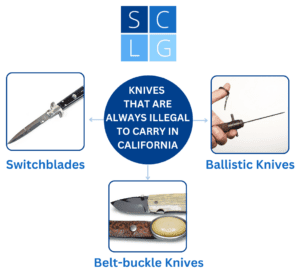
Certain knives are illegal to possess or transport in California—even in your vehicle.
❌ Prohibited Knives Under Penal Code
| Knife Type | Legal Code | Why It’s Illegal |
|---|---|---|
| Switchblades (≥2” blade) | PC 21510 | Opens automatically by button, spring, or motion |
| Gravity knives | PC 21510 | Opens via wrist flick or gravity |
| Ballistic knives | PC 16590 | Blade launches like a projectile |
| Concealed dirks/daggers (on person) | PC 21310 | Fixed-blade stabbing weapons carried hidden on body |
| Undetectable knives | PC 16590 | Not visible on X-ray scans |
| Disguised knives | PC 16590 | Cane swords, belt buckle knives, lipstick blades |
Important exception: A switchblade with a blade under 2 inches is legal. Some manufacturers sell “California-compliant” OTF (out-the-front) knives with sub-2” blades.
Fixed-Blade Knives: Storage Location Determines Legality

A fixed-blade knife is not automatically illegal in your car—but where it’s stored can make the difference between a legal tool and a criminal charge.
🔹 Stored in Glove Box or Console: Legal
- Keeping a fixed-blade knife in the glove compartment or center console is not considered “carried upon the person.”
- The California Court of Appeal ruled in People v. Steven Wade that items inside the passenger cabin but not on the body do not violate PC 21310 (concealed dirk/dagger law).
- This applies even if the knife is concealed from view.
🔹 On Your Person: Illegal if Concealed
- If the knife is in your pocket, waistband, backpack, or jacket—and not visible—it may be considered a concealed dirk or dagger.
- This is a wobbler offense, meaning it can be charged as either a misdemeanor or felony.
- Penalties: Up to 3 years in prison and a $10,000 fine.
🔹 Open Carry: Limited and Risky
- You can openly carry a fixed-blade knife only if it’s in a sheath suspended from your waist (PC 20200).
- However, cities like Los Angeles and Oakland ban open carry of knives with blades 3 inches or longer.
- Even if legal under state law, local bans override it.
Folding Knives: Always Legal When Closed
Folding knives are the safest option for legal knife carry in your vehicle.
✅ Legal When:
- Blade is closed
- Stored in pocket, bag, glove box, or console
No matter the blade length, a folding knife is legal in your car as long as it’s not a switchblade and is folded.
⚠️ Risk When Opened or Locked
- Once a folding knife is locked open, it may be classified as a dirk or dagger if used or intended as a weapon (per CALCRIM No. 2501).
- Never draw or brandish a knife during a traffic stop—even if legal.
Local Laws That Override State Rules
California allows cities to impose stricter knife laws. A knife legal under state law may be banned in certain municipalities.
🚫 Los Angeles: Strictest Knife Laws in CA
- Open carry banned for any knife with a blade 3 inches or longer
- Concealed carry of any knife is illegal, even folding ones
- Exceptions: Work, recreation, or religious use
- Safe storage: Keep large knives in the trunk—not glove box—to avoid suspicion
🚫 San Francisco: Loitering + Concealed Knives
- Illegal to loiter while carrying a concealed knife with a blade ≥3 inches
- Includes switchblades, ice picks, razors
- Does not apply if you’re just passing through
🚫 Oakland: Blade Length Ban
- Banned to carry any knife with a blade 3 inches or longer
- Applies even if folded or in a bag
- No exceptions for utility use
🚫 Sacramento County: Public Property Ban
- Knives prohibited on county property, including parks and government buildings
- Legal elsewhere under state law
Always check local codes before driving into a new city. Municipal websites or legal resources like Municode can help.
Where Knives Are Banned (Even If Legal Elsewhere)
Even legal knives become illegal in certain locations.
🏫 Schools and College Campuses
- PC 626.10(a) bans:
- Knives with blades over 2.5 inches
- Locking folding knives
- Dirks, daggers, ice picks
- Only exception: Non-locking folding knife with blade ≤2.5 inches
- Applies to school grounds, buses, and events
- Violation is a wobbler—up to 3 years in prison
🏛️ Government Buildings
- PC 171b prohibits knives with blades over 4 inches in:
- State or local government offices
- Public meetings open to the public
- Includes fixed-blade and locking folding knives
- Charged as misdemeanor or felony
✈️ Airports and Transit Hubs
- TSA rules: No knives allowed past security checkpoints, regardless of size
- Outside secure zones: state and local laws apply
- Never store a knife in carry-on luggage
🏞️ Federal Land (Parks, Bases, Forests)
- 15 U.S.C. §1241–1244 bans switchblades on federal property
- Violation: Up to 5 years in federal prison
- Exception: One-armed individuals with blades ≤3”
Intent Can Turn Legal Into Illegal
Owning a knife isn’t a crime—but why you have it matters.
🔍 How Police Judge Criminal Intent
- Saying the knife is for self-defense can be used as evidence of criminal intent
- Carrying it under your seat, wrapped, or hidden may suggest weapon use
- Case law (People v. Grubb): Carrying any object as a weapon against people is illegal
✅ What to Say If Stopped
- “This is for work—I use it for cutting packaging.”
- “It’s a utility tool I keep in my glove box.”
- Never say: “I carry it for protection.”
Best Practices for Safe Knife Storage in Your Car
Avoid legal trouble with these smart habits.
✅ Vehicle Storage Tips
- Trunk is safest – Ideal for fixed-blade knives, machetes, or tools
- Glove box is acceptable – But may draw scrutiny in LA or SF
- Center console okay – For folding knives, multitools
- Avoid under-seat storage – Seen as easily accessible weapon
- Lock it up – Use a locked case if carrying multiple tools
🧰 Work Tools: Prove Legitimate Use
- Keep receipts, toolkits, or job descriptions
- Store box cutters in a work bag or toolbox
- If questioned, show proof of occupational need
Penalties for Violating Knife Laws
| Offense | Code | Charge Type | Penalties |
|---|---|---|---|
| Concealed dirk/dagger | PC 21310 | Wobbler | Up to 3 years prison |
| Switchblade (≥2” blade) | PC 21510 | Misdemeanor | 6 months jail, $1,000 fine |
| Ballistic knife | PC 16590 | Misdemeanor/felony | Up to 3 years prison |
| Knife at school | PC 626.10 | Wobbler | Up to 3 years prison |
| Knife in government building | PC 171b | Wobbler | Same as above |
| Brandishing | PC 417 | Misdemeanor/felony | 30 days–3 years jail |
| ADW (knife used) | PC 245a1 | Wobbler | Up to 4 years prison |
| Knife enhancement | PC 12022 | Mandatory | +1 year to sentence |
A single knife can trigger multiple charges—especially if used in a crime.
Can You Use a Knife in Self-Defense?
Yes—but only under strict conditions.
✅ Legal Self-Defense Requires:
- Imminent threat of bodily harm
- Reasonable belief that force is necessary
- No more force than needed
- Knife must be legally carried
⚠️ Brandishing = Crime
- Even drawing a knife during an argument can be PC 417 violation
- No requirement to stab—threatening display is enough
✅ Safer Alternatives
- Pepper spray – Legal, non-lethal, easy to carry
- Stun gun – Permitted for self-defense
- Seatbelt cutter/window breaker – Legal, useful, no legal risk
FAQs: Quick Answers
Can I keep a knife in my glove box?
Yes. A knife in the glove compartment is not “on your person” and does not violate concealed carry laws.
Is a box cutter legal in my car?
Yes—if used for work. If carried for self-defense, it may be treated as a weapon.
Are OTF knives legal?
Only if blade is under 2 inches. Longer OTF (switchblade-style) knives are banned.
Can I carry a machete in my car?
Yes—store it in the trunk. Don’t carry it on your person.
Is a kubotan legal?
No. Kubotans are classified as metal knuckles under PC 21810—illegal to possess.
Are assisted-opening knives legal?
Yes. They require manual pressure (thumb stud), so they’re not switchblades.
How to Stay Legal: 7 Key Tips
- Avoid switchblades ≥2” – Even if legal elsewhere, they’re banned in CA
- Store fixed blades in trunk – Especially in LA, SF, or Oakland
- Use folding knives – Safest option for daily carry
- Check city laws – LA and Oakland are far stricter than state law
- Never brandish – Even legal use can lead to PC 417 charges
- Say it’s for work – If stopped, cite utility—not self-defense
- Keep documentation – Job receipts, toolkits, or project proof
Final Summary: What You Can Carry
| Knife / Situation | Legal in Car? | Notes |
|---|---|---|
| Folding knife (closed) | ✅ Yes | Any length, any location |
| Fixed-blade in glove box | ✅ Yes | Not on person = legal |
| Switchblade (<2” blade) | ✅ Yes | “CA-legal” OTF models allowed |
| Switchblade (≥2” blade) | ❌ No | Illegal to possess |
| Box cutter (work use) | ✅ Yes | Not for self-defense |
| Kubotan | ❌ No | Treated as brass knuckles |
| Knife in LA (≥3” blade) | ❌ No | Open or concealed banned |
| Knife in trunk | ✅ Yes | Safest storage method |
| Knife at school | ❌ No | Only ≤2.5” non-locking folding knife allowed |
| Knife in government building | ❌ No | If blade >4” |
Bottom Line: Yes, you can carry a knife in your car in California—if it’s a legal type, not on your person, and not in a restricted area. Always store fixed blades in the trunk, avoid switchblades over 2 inches, and double-check local laws before entering cities like Los Angeles or Oakland. Your safest bet? A folding knife, closed, stored in the console—and never used as a threat.