A rusted knife blade isn’t just an eyesore—it can dull your edge, weaken the steel, and even compromise food safety in kitchen tools. Whether you’ve left a pocket knife in the rain, stored a survival tool in a damp drawer, or forgotten a chef’s knife in the sink, knowing how to remove rust from a knife blade is essential for restoring performance and longevity. The good news? Most rust can be reversed—especially when caught early.
From everyday pantry staples like vinegar and baking soda to precision tools like rust erasers and sharpening slurry, there are safe, effective methods for every level of corrosion. This guide walks you through proven techniques backed by real-world restorations, helping you assess rust severity, choose the right treatment, and protect your blade long after cleaning.
Let’s bring your knife back to life—step by step.
Assess Rust Severity Before Treatment

Jumping straight into aggressive cleaning can damage your blade. First, inspect the rust under bright light or with a magnifying glass. Shine a flashlight across the surface to spot texture changes invisible to the naked eye.
Light Surface Rust
This appears as a thin, dark or brownish film—more of a stain than a scar. It hasn’t penetrated the metal and feels smooth.
- Safe methods: Baking soda paste, WD-40 + 0000 steel wool, or a quick lemon-salt scrub.
- Don’t overdo it: Aggressive tools will scratch unnecessarily.
Medium Rust
Rust is now flaky, patchy, and slightly raised. You may feel roughness when running a finger along the blade.
- Best options: Vinegar soak (for stainless steel), rust eraser, or fine steel wool.
- Avoid skipping steps: Start gentle, then escalate only if needed.
Heavy or Pitted Rust
Deep red-orange corrosion with visible craters or crumbling edges. This level compromises structural integrity.
- Only options: Sandpaper (400+ grit), commercial rust removers, or professional help.
- Important: Pitting cannot be reversed—only cleaned and stabilized to prevent further spread.
Pro Tip: If rust has reached the handle tang or pivot area, disassemble the knife carefully and treat each part individually.
Vinegar Soak for Medium to Heavy Rust
White distilled vinegar works fast thanks to its acetic acid, which breaks down iron oxide.
How Long to Soak?
- Light rust: 15–30 minutes
- Medium rust: 1–2 hours
- Heavy rust: Up to 12 hours (check every few hours)
Never exceed 24 hours—prolonged exposure risks etching or weakening the steel.
Step-by-Step Vinegar Treatment
- Pour vinegar into a cup and submerge only the rusted section.
- After soaking, scrub with a soft toothbrush or non-abrasive pad.
- Rinse thoroughly with soapy water to neutralize acid residue.
- Dry immediately with a lint-free cloth—air drying invites new rust.
Note: Vinegar may darken the blade. This can be polished off later with a rust eraser or slurry.
Warning: Avoid on 1095 carbon steel (e.g., Schrade Old Timers)—risk of hydrogen embrittlement.
Baking Soda Paste for Gentle, Food-Safe Cleaning
A non-toxic, kitchen-friendly method ideal for light rust and daily maintenance.
Make the Right Paste
- Mix 2 parts baking soda to 1 part water.
- Stir until thick—should cling without dripping.
Application Steps
- Apply directly to rust spots with a cloth or fingertip.
- Let sit:
– 5–10 minutes for minor discoloration
– 1–2 hours for stubborn stains - Gently scrub with:
– Toothbrush
– Soft sponge
– Damp paper towel - Rinse well and dry completely.
Bonus Hack: Apply baking soda, then spritz with vinegar for a fizzing reaction that lifts grime—but rinse fast to avoid moisture buildup.
Avoid on mirror-polished blades—can leave micro-scratches if rubbed too hard.
Lemon Juice and Salt: Natural Rust Remover
This method uses citric acid and mild abrasion—perfect for kitchen knives.
How to Apply
- Sprinkle coarse salt (sea or kosher) on the rust.
- Squeeze fresh lemon juice to form a slurry.
- Wait 15–30 minutes—do not exceed on carbon steel.
- Scrub with:
– Lemon rind (natural abrasive)
– Soft sponge
– Toothbrush - Wash with soap, rinse, and dry immediately.
Alternative: Mix lemon juice with baking soda for a gentler paste.
Never use bottled lemon juice—preservatives reduce cleaning power.
Potato Rust Removal: Safe for Cooking Knives
Raw potatoes contain oxalic acid, a natural rust dissolver—ideal for food-contact blades.
Two Effective Techniques
A. Rub Method
- Cut a potato in half.
- Dip the cut side in baking soda or salt.
- Rub in circular motions over rusted areas.
- Wipe clean, rinse, and dry.
B. Soak Method
- Insert the blade into a whole raw potato.
- Leave for 1–3 hours, or overnight for tough spots.
- Remove, wash with soap, and dry completely.
Caution: Don’t leave longer than 12 hours—trapped moisture breeds more rust.
Best for: Carbon steel kitchen knives where food safety matters.
Steel Wool (0000 Grade Only) for Precision Rust Removal

Fine steel wool removes rust mechanically without deep scratching—when used correctly.
Why Use Oil First?
- Apply WD-40, mineral oil, or gun oil to the rusted area.
- Wait 3–5 minutes—oil penetrates and softens corrosion.
Proper Scrubbing Technique
- Use 0000 (fine) or 00 (extra fine) steel wool only.
- Rub in one direction, following the grain of the metal.
- Wipe clean with a cloth.
- Re-oil after treatment.
Never use on the cutting edge—can dull or roll the edge.
Avoid coarse grades (0 or lower)—they cause visible scratches.
Pro Tip: Dampen the blade with water, sprinkle baking soda, then scrub—enhances cleaning.
Scouring Pads and Rust Erasers for Controlled Abrasion
These tools remove rust with minimal damage to the finish.
A. Scotch-Brite or 3M Green Pad
- Use the fine side first.
- Soften with water to reduce abrasiveness.
- Rub in long, even strokes.
Military Use: 3M green pads were standard for artillery maintenance (PX24 equivalent).
B. Rust Eraser (e.g., Naniwa, Su-Hero)
- Rubber-based with embedded silicon carbide.
- Soak in water for 5 minutes before use.
- Ideal for carbon steel and Damascus blades.
How to Use
- Soak eraser in water.
- Rub over rust, following grain.
- Re-wet as needed.
- Rinse, wash, dry.
Advantage: Removes rust without marring high-polish finishes.
Finger Stones and Sharpening Slurry (Pro Restoration)
For high-end or collectible blades needing precision cleaning.
Make Your Own Slurry
- Grind fragments of old sharpening stones into powder.
- Mix with water to form a thick paste.
- Apply with cloth, paper towel, or mesh pad.
Grit Progression Strategy
- Start with 700–1000 grit to remove rust.
- Drop to 220 grit for deep stains (if needed).
- Finish with 3000+ grit for mirror polish.
Alternative: Collect slurry from flattening a stone—store in a sealed container for reuse.
Best for: Damascus, tanto, or custom blades where finish matters.
Commercial Rust Removers for Stubborn Corrosion
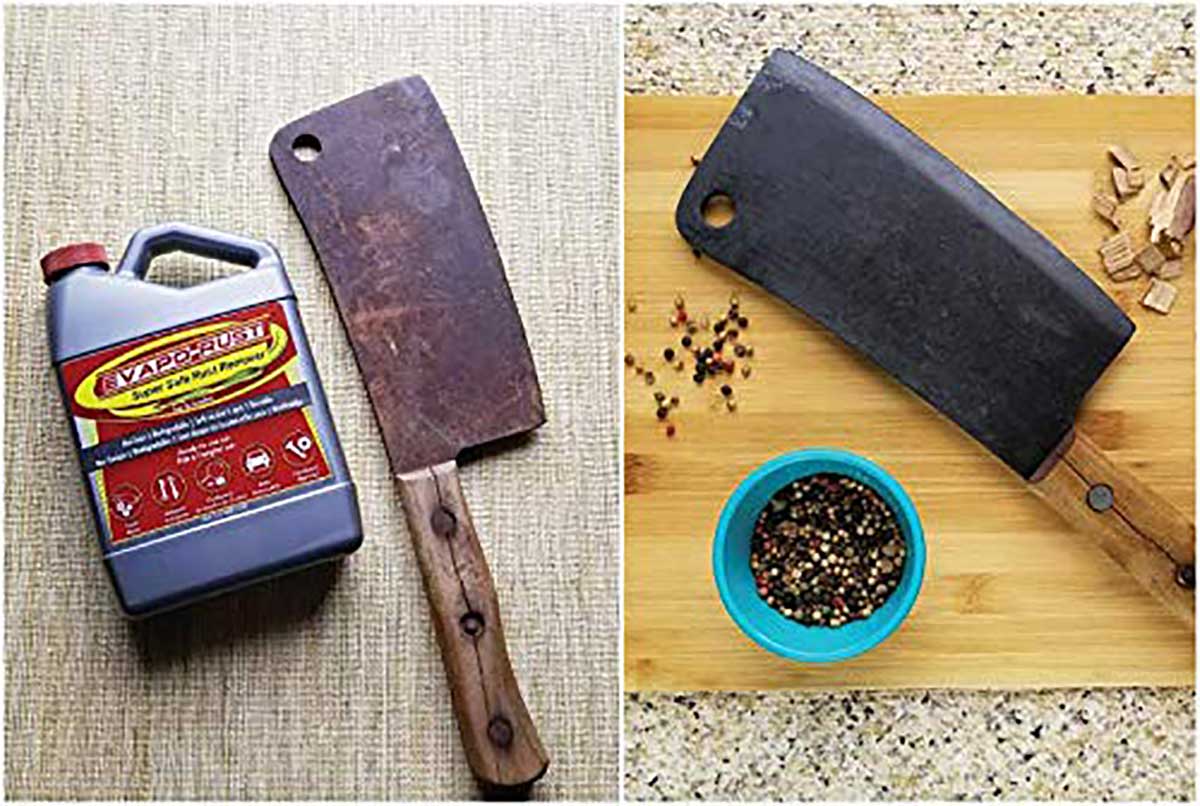
When DIY methods fail, trusted products deliver fast results.
Top-Rated Options
| Product | Best For | Notes |
|---|---|---|
| Evapo-Rust | Non-toxic, deep rust | May darken metal—scrub after soak |
| Krud Kutter | Spot treatment | Less aggressive, good for beginners |
| Naval Jelly | Fast phosphoric acid action | Corrosive—wear gloves and ventilate |
| CRC Rust Dissolver | Industrial-strength | Use sparingly; can damage handles |
Application Tips
- Apply only to rusted areas.
- Follow label instructions exactly.
- Test on a small area first.
- Rinse and dry thoroughly.
Real-World Use: Evapo-Rust restored a 90-year-old Remington knife—brushed with brass after soaking.
WD-40 for Light Rust and Lubrication
Penetrates rust and protects metal—ideal for pre-treatment.
How to Use
- Spray or apply WD-40 to rusted spot.
- Wait 3–5 minutes.
- Scrub with 0000 steel wool or cloth.
- Wipe clean.
- Re-oil with food-safe or blade-specific oil.
Warning: WD-40 is not food-safe—never use on cooking knives without thorough cleaning afterward.
Safe for: Synthetic handles (e.g., Delrin on Schrade Old Timers).
Copper Penny Trick for Deep Rust in Crevices
Useful for rust in pivots, hinges, or hard-to-reach spots.
Why a Pre-1982 Penny?
- Higher copper content—more effective and softer on metal.
Step-by-Step
- Apply solvent (e.g., Hoppe’s #9) to rusted area.
- Gently scrape with edge of penny.
- Finish with 0000 steel wool.
- Clean and oil.
Mechanism: Copper acts as a soft scraper with slight galvanic action.
Best for: Folding knives, tactical blades, hinge areas.
Sandpaper for Severe Rust (Last Resort)
Removes rust by abrading the surface—effective but labor-intensive.
Grit Sequence
- Start with 400–600 grit (remove rust and pitting).
- Progress to 1000, 2000, 3000 grit (polish out scratches).
- Always work in one direction.
Power Option: Use a mouse sander for flat blades—start at 100 grit, go up to 3000.
Warning: Sanding alters blade finish and dimensions—avoid on antiques or collectibles.
Special Blade Type Guidelines
Different steels require different care.
Carbon Steel Knives
- Highly reactive—rusts fast, develops patina.
- Best methods: Baking soda, rust eraser, light oil.
- Avoid: Long vinegar soaks, Bar Keepers Friend (BKF).
- Tip: A dark patina is protective—don’t remove it unless it’s flaking.
Stainless Steel Knives
- Rust-resistant, not rust-proof.
- Can handle vinegar, commercial removers, steel wool.
- Still requires drying and oiling.
Damascus Steel Blades
- Layered pattern can be damaged by acid or coarse abrasives.
- Use only: 0000 steel wool, rust erasers, slurry.
- Avoid: Vinegar, lemon, Naval Jelly.
Antique or Collectible Knives
- Preservation > restoration.
- Avoid methods that remove original finish or markings.
- Consult a professional for rare or valuable pieces.
Schrade Old Timer (1095 Steel)
- Made from high-carbon 1095 steel.
- Safe: WD-40 + 0000 steel wool.
- Avoid: Vinegar, acids—risk of embrittlement.
- For deep rust: Copper penny + solvent + fine steel wool.
Post-Cleaning Care: Rinse, Dry, Oil
Cleaning isn’t complete until the blade is protected.
Final Steps
- Rinse with mild dish soap and water.
- Dry immediately with a soft, lint-free cloth—never air-dry.
- Apply oil:
– Mineral oil (kitchen knives)
– Gun oil (tactical/outdoor)
– Camellia oil (traditional Japanese care) - Let sit 5–10 minutes.
- Buff with clean cloth.
Golden Rule: Reapply oil after every wash or use.
Prevent Rust Before It Starts
The best rust removal is the one you never need.
Daily Habits
- Wipe blade after every use.
- Dry immediately—especially after cutting acidic foods.
- Never put in dishwasher—heat and detergents accelerate corrosion.
Storage Tips
- Store in dry place: knife block, magnetic strip, sheath.
- Add silica gel packets to drawers or cases.
- For long-term storage, apply a thin wax coating.
Maintenance Schedule
- Weekly: Inspect for early rust signs.
- Monthly: Re-oil even if blade looks dry.
- After heavy use: Clean and oil immediately.
Pro Insight: A thin oil film is the best defense—like sunscreen for your steel.
With prompt action and consistent care, even a heavily rusted knife can return to reliable service. Start gentle, escalate only as needed, and always finish with polish and protection. Keep your blades clean, dry, and oiled—and they’ll last a lifetime.