If you’ve ever seen a blade shoot straight out from the front of a sleek handle with a sharp snap, you’ve just witnessed an Out-the-Front (OTF) knife in action. Unlike traditional folding knives that pivot open from the side, OTF knives deploy their blades in a perfectly straight line—directly out the front of the handle—powered by internal springs and precision mechanics. Understanding how an OTF knife works reveals a compact marvel of engineering, where every component, from the spring to the slider, plays a crucial role in delivering fast, reliable, one-handed cutting power.
These knives are favored by tactical users, first responders, and everyday carry (EDC) enthusiasts who need instant access without fumbling. At their core, OTF knives store energy in a spring, which is released the moment a locking detent disengages. Whether it’s a single-action OTF that launches the blade forward with a push or a double-action model that retracts it just as smoothly with a pull, the mechanism is a symphony of timing and tension. While they may look simple from the outside, inside lies a tightly engineered system of tracks, latches, and moving parts. This guide breaks down exactly how OTF knives function, the differences between SA and DA models, and what keeps them running—or what causes them to fail.
OTF Knife Core Components
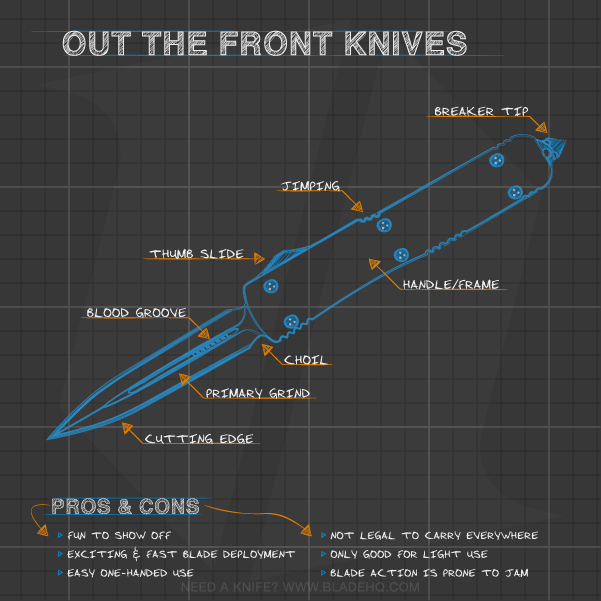
Every OTF knife relies on a set of precisely machined internal parts that work together to ensure smooth, repeatable blade movement and secure locking in both open and closed positions.
Blade with Stop Pin and Notch
The blade in an OTF knife isn’t just for cutting—it’s a moving component designed to interface with the firing mechanism. It features a stop pin or notch near the base that connects to the spring and travel track. As the blade moves forward or back, this pin ensures it travels in a straight line and stops at precise points. Many blades also include small alignment discs or bearings to reduce friction and prevent wobble during deployment.
Precision Milled Handle Track
The handle does more than house components—it guides the blade. Inside, a milled groove or track runs front to back, constraining the blade’s movement to a straight path. This prevents side-to-side play that could cause jamming. Handles are typically made from aluminum, titanium, or G10, balancing strength and weight. The external design often includes a pocket clip or scales, but these don’t affect function.
Spring-Powered Energy System
The main spring is the heart of the OTF mechanism. In most models, it’s a tension or compression spring that stores energy when stretched or compressed by the slider. When released, it snaps the blade forward (or pulls it back in double-action models). The spring connects to the blade via the stop pin and to a steel plate that translates user input into motion.
Slider-Actuated Steel Plate
The slider, thumb slide, or trigger button is the external control you press or pull. It’s directly linked to the steel plate (also called a pusher or actuator), which moves in sync with your input. This plate has an angled tab or cam that interacts with the locking latches. As it moves, it disengages the detents at the right moment to allow blade motion.
Front and Rear Locking Detents
Two spring-loaded latches secure the blade:
– The front detent locks the blade when fully extended.
– The rear detent holds it when retracted.
These detents press into notches or flat surfaces on the blade, producing a satisfying click when engaged. The steel plate’s cam action gradually lifts them out of the way during operation.
Optional Safety Switch
Many single-action OTFs include a manual safety switch that blocks the slider. This prevents accidental deployment in your pocket. Double-action models often skip this feature because their mechanism requires deliberate forward and backward motion, making unintentional activation unlikely.
Single-Action vs Double-Action OTF Mechanisms
The biggest functional difference in OTF knives is whether they are single-action (SA) or double-action (DA). This determines how the blade opens and closes—and how much user effort is required.
Single-Action OTF: Spring-Opened, Manual Closed
How It Deploys
- You push the slider forward.
- The steel plate moves, and its angled tab lifts the rear detent.
- The main spring releases, yanking the blade forward.
- The blade extends fully and locks into place via the front detent.
How It Retracts
- You press a release (often the same slider).
- The front detent disengages.
- You manually pull the blade back into the handle.
- The stop pin re-cocks the spring.
- At full retraction, the rear detent clicks back in.
Why It’s Reliable
- Simpler design means fewer failure points.
- Full spring power is used only for deployment, ensuring strong, consistent ejection.
- Common in tactical and budget-friendly models like Smith & Wesson SA-OTFs.
Double-Action OTF: Spring-Powered Both Ways
How It Deploys
- You push the slider forward.
- The steel plate stretches the main spring.
- The rear detent is lifted by the cam tab.
- The spring snaps the blade forward and locks it with the front detent.
- The mechanism automatically resets for retraction.
How It Retracts
- You pull the slider backward.
- The steel plate moves rearward, stretching the spring in reverse.
- The front detent is disengaged.
- The spring pulls the blade back into the handle.
- The rear detent re-engages at full retraction.
Why It’s Convenient
- True one-handed open and close.
- No manual blade pulling—ideal for gloves or wet conditions.
- Found in high-end models like Microtech Ultratech and Protech Dark Angel.
Mechanical Principles Behind OTF Operation
Spring Energy and the Slingshot Effect
OTF knives work like a slingshot. When you move the slider, you stretch the spring, storing potential energy. Once the detent clears its notch, that energy releases instantly, launching the blade. The speed depends on spring tension, travel distance, and internal friction.
Linear Blade Guidance
Unlike folding knives, OTF blades don’t pivot—they slide straight out. The stop pin rides in the milled track, keeping motion perfectly linear. Without this, the blade could bind or fail to lock. Any debris in the track can disrupt alignment, which is why cleaning is critical.
Detent Timing and Lock Security
The angled tab on the steel plate acts as a cam, gradually lifting the detent until it clears the blade’s locking surface. This creates a tactile bump and audible click, signaling full lockup. Poorly timed detents can cause partial locks or failure to deploy.
DA-OTF Spring Reset
In double-action models, the spring automatically reconfigures after deployment. This allows it to power retraction without user reset. This reset is what makes DA-OTFs more complex—and more impressive—mechanically.
Safety Features in OTF Knives
Active Safety Switch
Found on most SA-OTFs, this physical switch blocks the slider. It’s essential for safe carry, especially in pockets. Flip it on, and the knife won’t deploy even if pressed.
Passive Bump Safety
Many DA-OTFs are bump-safe by design. If the blade hits an obstacle during ejection, it won’t fully extend or lock—because it relies on momentum to reach the front detent. This prevents accidental injury if the knife is jostled.
Lock Integrity and Wobble Checks
A secure lock means both front and rear detents engage fully. If you feel blade wobble, it’s a sign of worn parts, debris, or loose tolerances. Never use a knife with an unstable lock—it can collapse during use.
Top OTF Knife Brands and Design Differences

Microtech: High-End DA-OTFs
- Models: Ultratech, Troodon, HALO VI
- Features: Double detents, titanium handles, S35VN steel
- Known for smooth action, precision machining, and reversible clips
- Higher price, but legendary reliability
Benchmade: Tactical SA and DA Options
- Models: Infidel (DA), Pagan (SA)
- Builds: CNC aluminum, 440C or CPM-20CV blades
- Focus on field durability and ergonomic design
- Trusted by military and law enforcement
Protech: Premium DA-OTF Craftsmanship
- Models: Dark Angel, 2013, Tread
- Traits: Tight tolerances, titanium frames, glass-filled nylon blades
- Favored for consistency and smooth slide action
- Often used by collectors and pros
Smith & Wesson: Entry-Level SA-OTFs
- Affordable, simple single-action models
- Great for beginners learning OTF mechanics
- Less refined than high-end brands, but functional
Hogue: Ergonomic Compound OTFs
- Models: Compound series
- Design: G10 handles, tactical grip, smooth DA mechanism
- Balances comfort and performance
- Popular for EDC and self-defense
Practical Uses of OTF Knives
Emergency Access
- Cut seatbelts after accidents
- Slice through clothing or ropes in rescue scenarios
- Deploy in low-visibility or high-stress situations with one hand
Everyday Carry (EDC)
- Open packages, cut tape, slice cardboard
- Ideal for gloved hands or wet conditions (DA-OTFs)
- Compact size fits in pocket or kit
Tactical and Self-Defense
- Fast deployment gives critical time advantage
- Used by security personnel, officers, and preppers
- Not a substitute for training, but a force multiplier
Collecting and Mechanical Interest
- Admired for engineering elegance
- Watch the mechanism in slow motion—some owners do it for fun
- Limited editions and custom builds hold value
Legal Status of OTF Knives
U.S. Federal Law
- Legal to own and sell in most cases
- Not restricted under the Federal Switchblade Act if shipped across state lines
- But state and local laws vary widely
State Restrictions
- Banned in: California, New York, Massachusetts, New Jersey, Michigan
- Restricted in: Illinois, Minnesota, Texas (with conditions)
- Always check local statutes before purchasing or carrying
Air Travel Rules (TSA)
- Prohibited in carry-on bags
- Allowed in checked luggage
- But destination state laws may still ban possession
- Never assume it’s safe to fly with one
OTF Knife Maintenance Guide
Due to their complexity, OTF knives need regular care to stay reliable.
Cleaning the Mechanism
- Wipe the blade after each use
- Use a soft brush or toothpick to clear debris from the track
- For deep cleaning: extend the blade first (to avoid spring release)
- Remove dust, lint, or pocket gunk that can jam the slide
Lubrication Points
Apply light knife oil (e.g., Tri-Flow, Rem Oil) to:
– Blade track
– Spring
– Steel plate
– Detent contact points
Avoid over-lubing—excess attracts dirt.
Inspection Checklist
Check monthly for:
– Weak or slow deployment (sign of spring fatigue)
– Loose screws in handle
– Blade wobble or incomplete lockup
– Slider resistance (too stiff or too loose)
Storage Tips
- Keep in a dry, cool place
- Use a protective case or sheath
- Avoid humidity to prevent rust on steel parts
Prevent Seizing
- Deploy and retract the blade occasionally
- Even if unused, cycling keeps springs and latches functional
- Prevents mechanical seizing from inactivity
Advantages of OTF Knives
Fastest One-Handed Deployment
- No flipping, no flicking—just push and go
- Faster than most manual folders
True One-Handed Use (Especially DA-OTFs)
- Open and close without switching hands
- Ideal for gloves, injury, or awkward angles
Compact and Pocket-Friendly
- No blade exposure when closed
- Slides in and out of pockets smoothly
Smooth, Repeatable Action
- High-end models feel like precision instruments
- Satisfying click and snap with every cycle
Engineering Appeal
- Fascinating to watch and use
- A favorite among gearheads and tinkerers
Disadvantages to Consider
Complex Mechanism = Higher Failure Risk
- More parts = more things that can go wrong
- Dirt, sand, or lint can jam the track
- Not ideal for dirty environments without frequent cleaning
Higher Cost
- DA-OTFs can cost $200–$400+
- More than most manual folders or basic autos
Legal Restrictions
- Banned in many states
- Can’t be carried openly or concealed without risk
Weaker Lockup Than Framelocks
- Detent locks aren’t as strong as titanium frame locks
- Not for prying, batoning, or heavy tasks
Spring Fatigue Over Time
- Springs weaken with repeated use
- May need replacement every few years
- Not user-replaceable on all models
Not Built for Abuse
- Designed for cutting, not hammering
- Avoid using as a screwdriver, pry bar, or chisel
Frequently Asked Questions
Can an OTF knife open in your pocket?
Unlikely. Most require deliberate slider movement with noticeable resistance. Active safety switches (on SA models) add extra protection. However, a damaged or loose mechanism could malfunction—so inspect regularly.
What’s the difference between a switchblade and an OTF?
- Switchblade: Blade folds out from the side (out-the-side).
- OTF knife: Blade extends straight out the front.
Mechanisms differ in layout and motion. OTFs are a subset of automatic knives.
Are OTF knives good for self-defense?
They offer fast access, which is valuable. But legality, reliability, and training matter more. In restricted states, carrying one could lead to arrest. Use only where legal and with proper mindset.
How long do OTF springs last?
With proper care, thousands of cycles. High-end models like Microtech often last 5+ years of daily use. Avoid dry-firing and keep lubricated to extend life.
Can you repair an OTF knife?
Yes—but disassembly is risky. Many manufacturers offer factory service. Attempting DIY fixes without tools or knowledge can ruin the mechanism.
An OTF knife works by harnessing spring energy, guided linear motion, and precision detent locks to deliver instant blade access with a simple push or pull. Whether single-action for reliability or double-action for full automation, these knives represent a blend of speed, engineering, and practicality. While they demand more maintenance and legal awareness than manual folders, their performance in critical moments makes them a top choice for EDC, tactical use, and mechanical appreciation. Choose wisely, maintain regularly, and always respect the laws in your area.