You’ve seen the scene a hundred times: a character takes a brutal knife thrust to the chest, staggers back, then pulls open their jacket to reveal a “bulletproof” vest—unharmed. It makes for great drama, but in real life, that survival is more fiction than fact. If you’re counting on Kevlar to protect you from a knife, here’s what you need to know: a sharp knife can absolutely go through standard Kevlar—especially if it’s designed only to stop bullets.
Kevlar is legendary for its strength—five times stronger than steel by weight—and is the foundation of most soft body armor. But its performance against knives depends entirely on how it’s engineered. Ballistic Kevlar stops bullets by absorbing and dispersing high-speed kinetic energy across layers. A knife, however, doesn’t rely on speed; it uses focused shear force to slice through fibers like scissors through thread. That’s why standard bullet-resistant vests offer little to no reliable protection against stabbing attacks.
The hard truth? Kevlar alone isn’t knife-proof. But when specially designed, layered, and combined with other materials, it can stop a blade. The key is understanding the difference between ballistic protection and stab resistance—and choosing armor certified for the threat you actually face.
In this guide, you’ll learn exactly how knives defeat regular Kevlar, what makes stab-resistant armor work, and how to pick real protection—based on NIJ standards, material science, and real-world testing.
Why Knives Can Cut Through Standard Kevlar
Shear Force vs. Tension: The Mechanical Weakness
Kevlar thrives under tension, the stretching force generated when a bullet slams into the vest. The tightly woven aramid fibers stretch and spread the impact energy across multiple layers, slowing and stopping the projectile. But a knife attacks differently. Instead of stretching the fibers, it applies shear force, sliding between and severing them.
Think of it like this:
– A bullet is like a baseball hitting a chain-link fence—it gets tangled and stops.
– A knife is like wire cutters—it slices right through the links.
This fundamental mismatch means standard Kevlar vests are not built to resist cutting motions. Even a legal pocket knife, when driven with force, can penetrate multiple layers of ballistic-grade Kevlar in a single stab.
Blade Sharpness and Penetration Power
A sharp blade dramatically increases the risk of penetration. The sharper the edge, the less force needed to concentrate pressure on a tiny point. Tests show that as little as 8–10 pounds of force can drive a thin, pointed blade through standard Kevlar.
- Kitchen knives, box cutters, and folding knives all have narrow tips that focus force.
- Even non-weaponized blades (like those under 3 inches) can breach the vest if sharp enough.
- Dull blades may catch or snag, but a clean, sharp edge slices through fibers with ease.
Real-world testing confirms that common knives can penetrate both ballistic gel and Kevlar vests in one motion—simulating life-threatening injuries to vital organs.
Attack Angle and Motion Matter
- Direct stabs are the most dangerous, maximizing force concentration and penetration depth.
- Slashing motions are less likely to cause deep wounds but can still damage the fiber weave over time.
- Repeated slashes in the same area weaken the structural integrity, making full penetration easier on subsequent strikes.
Even a glancing cut can compromise the vest’s protection. Internal damage may not be visible, but once fibers are severed, the armor’s effectiveness drops significantly.
Ballistic vs. Stab-Resistant Armor: Not the Same
Why You Can’t Rely on One for Both
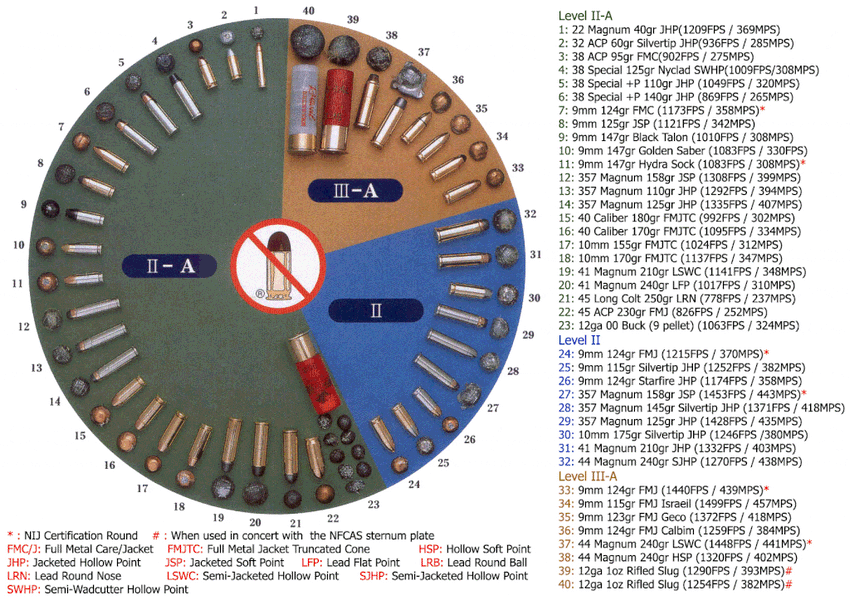
A ballistic vest is not a stab vest, and vice versa. These are engineered for entirely different threats:
| Feature | Ballistic Armor | Stab-Resistant Armor |
|---|---|---|
| Threat Type | High-speed bullets | Knives, ice picks, edged tools |
| Protection Method | Spreads kinetic energy | Catches or traps the blade |
| Materials Used | Kevlar (tension-focused) | Kevlar + cut-resistant weaves, hard plates |
| Penetration Rule | Zero penetration allowed | Up to 20mm allowed (no skin breach) |
| NIJ Standard | Level II, IIIA, etc. | Spike 1–3, Edged Blade 1–3 |
Bottom line: A vest rated to stop a .357 Magnum round won’t save you from a kitchen knife—unless it’s explicitly certified for stab resistance.
How NIJ Stab Resistance Standards Work
The National Institute of Justice (NIJ) sets the U.S. standard for stab-resistant armor. These tests are separate from ballistic ratings and simulate real attack conditions.
Spike Resistance Levels
- Level 1: Withstands spikes up to 17.7 foot-pounds of force
- Level 2: Up to 24.3 foot-pounds
- Level 3: Up to 31.7 foot-pounds
A foot-pound is the energy of one pound of force applied over one foot—roughly equivalent to a forceful stab.
Edged Blade Testing
- Uses standardized knives dropped from fixed heights to simulate attacks.
- Must stop penetration beyond 20 mm into the backing material (mimicking human tissue).
- Must withstand multiple strikes in the same area.
No certification? No guarantee. If a vest lacks an official NIJ label for edged blade or spike resistance, it’s not tested for knife defense.
Materials That Actually Stop Knives

1. Stab-Resistant Kevlar
Not all Kevlar is the same. When used for knife defense, it’s:
– Tightly woven or laminated to resist cutting
– Often coated with resins to stiffen the fabric
– Layered to trap blades instead of letting them slice through
But standalone Kevlar isn’t enough for high-force attacks.
2. Dyneema
- Made from ultra-high-molecular-weight polyethylene (UHMWPE)
- Lighter than Kevlar, with superior cut resistance
- Used in military and law enforcement stab vests
3. High-Density Polyethylene (HDPE)
- Dense molecular structure makes it nearly impossible to puncture
- Often used in hard plates for hybrid armor
4. Ceramic and Steel Plates
- Ceramic plates shatter blade tips on impact.
- Steel plates deflect or crush blades but add weight.
- Most effective when paired with soft armor layers.
5. Composite Systems (e.g., TurtleSkin)
- Combine metal mesh with high-strength fibers
- Designed to catch and bind the blade tip
- Common in corrections and high-risk security
These systems are why some vests stop both bullets and knives—but only if explicitly rated for both.
Can These Armor Types Stop a Knife?
Standard Bulletproof Vest?
No. A typical NIJ Level II or IIIA vest is not tested for stab resistance.
- May resist light slashes due to fiber density
- But a focused stab will likely penetrate
- Real test: A folding knife cut through a standard vest in one motion
Never assume ballistic = stab protection.
Plate Carrier with Hard Plates?
Yes—on the plate.
- If a knife strikes a ceramic, steel, or HDPE plate, it will likely be stopped.
- But side panels, back, and soft areas remain vulnerable.
- Plate carriers without stab-rated soft armor leave gaps in edged weapon defense.
Stab-Resistant Vest vs. Bullet?
Generally no.
- Stab vests allow controlled blade entry to absorb energy—fine for knives, deadly for bullets.
- They lack the layered dispersion needed to stop high-speed projectiles.
- Only hybrid-certified models offer reliable dual protection.
How Stab-Resistant Vests Actually Work
Trapping the Blade, Not Just Stopping It
Unlike ballistic armor, which must stop all penetration, stab-resistant vests:
– Allow up to 20 mm of blade entry
– Use dense, cut-resistant layers to catch and bind the tip
– Prevent the blade from reaching vital organs
The goal isn’t to stop the knife cold—it’s to limit penetration depth and prevent skin breach.
Durability After an Attack
- Some vests can withstand multiple stabs, depending on location and force.
- But any known impact requires replacement—internal damage isn’t always visible.
- Moisture, UV exposure, and age degrade performance over time.
Rule of thumb: Replace after any penetration, heavy impact, or 5–7 years of use.
Who Needs Stab-Resistant Armor?
Law Enforcement & Security
- UK police wear stab-resistant vests due to high knife crime.
- US corrections officers use stab armor for close-quarters threats.
- Tactical units often use dual-certified armor for multi-threat environments.
Civilians in High-Risk Areas
- Urban areas with knife violence require stab-focused protection.
- “Bulletproof” vests sold online often lack stab certification.
- Always check for NIJ labels—don’t trust marketing terms like “tactical” or “military-grade.”
Debunking Common Myths
Myth: “Kevlar Is Knife-Proof”
False. Standard Kevlar is cut-vulnerable. Only specially engineered versions resist knives.
Myth: “Higher Ballistic Rating = Better Knife Protection”
Not true. A Level IIIA vest may be thicker, but it’s not optimized for shear forces. Without stab certification, it’s not reliable.
Myth: “All Body Armor Stops Knives”
Dangerous assumption. No armor is 100% effective. Protection reduces risk, not eliminates it.
How to Choose Real Knife Protection
1. Identify Your Threat
- Guns? → Go for ballistic-rated armor (NIJ II–IV).
- Knives? → Choose stab-resistant armor (NIJ Spike or Edged Blade 1–3).
- Both? → Invest in dual-certified hybrid armor.
2. Verify NIJ Certification
- Look for official NIJ labels inside the vest.
- Confirm edged blade or spike resistance—not just ballistic.
- Avoid unlabeled or “self-certified” products.
3. Fit and Comfort Matter
- A loose vest leaves gaps; a tight one restricts movement.
- Choose breathable, lightweight materials for daily wear.
- Ensure mobility for your role.
4. Inspect and Replace
- Check monthly for fraying, compression, or moisture damage.
- Replace after any impact, penetration, or 5–7 years.
- Store in a cool, dry place away from sunlight.
Final Answer: Can a Knife Go Through Kevlar?
Yes—standard Kevlar used in bullet-resistant vests can be penetrated by a knife.
Kevlar resists tension (bullets) but not shear (knives). A sharp blade can cut through the fibers with minimal force, making ballistic vests unreliable against edged weapons.
However, Kevlar can stop a knife when:
– It’s specifically engineered for stab resistance
– It’s tightly woven, coated, or layered with cut-resistant materials
– It’s part of a NIJ-certified stab-resistant or hybrid system
Key Takeaways:
- Ballistic ≠ Stab-resistant. Never assume one protects against both.
- Look for NIJ certification—not marketing claims.
- Hybrid armor offers the best defense in unpredictable environments.
- No vest is 100% impenetrable, but the right choice dramatically reduces injury risk.
If you’re facing knife threats, don’t rely on a standard Kevlar vest. Choose dedicated stab-resistant armor—because when seconds count, the right protection can mean the difference between life and death.